
The article demonstrates that ergothioneine is an evolutionarily significant fungal molecule for which the human body even possesses its own transporter. It protects against oxidative stress, supports the mitochondria, brain, and metabolism, and may be important for healthy aging. In addition, the text highlights other highly relevant fungal compounds such as erinacine, hericenones, and cordycepin.
The core thesis: The future lies in synergistic mushroom formulations for prevention, neuroprotection, and metabolic health.
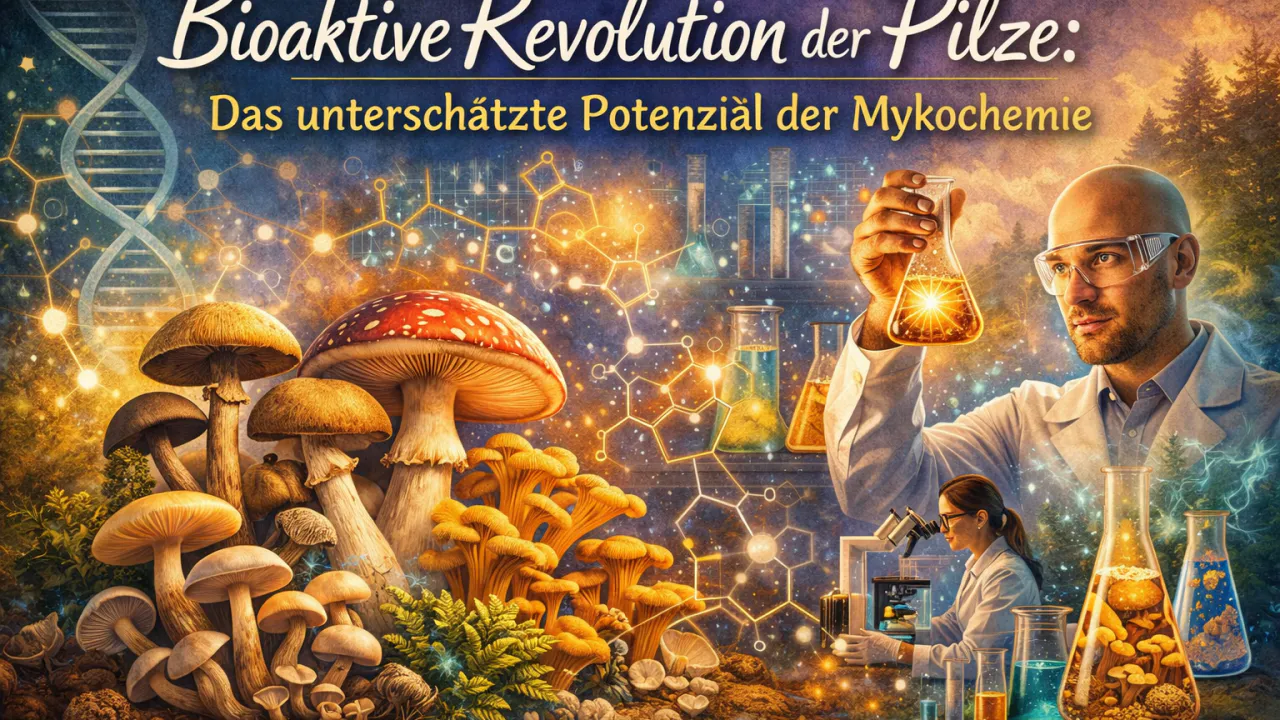
Nature is rarely wasteful. When the human body develops a dedicated transporter for a single compound—a specialized molecular gateway that has been conserved over millions of years of evolution—it is worth taking a very close look at what that compound is and why it was apparently so important that the genome reserved capacity for it.
This is exactly the case with ergothioneine. A transport protein called OCTN1 exists in the human body with a single, biologically relevant function: to transport ergothioneine from the intestines into the tissues and specifically accumulate it there—in the mitochondria, the liver, the brain, red blood cells, and bone marrow. Everywhere where oxidative stress can be particularly devastating.
This is not a biochemical coincidence. It is an evolutionary argument.
And yet ergothioneine is virtually unknown to the general public. That is likely to change—for at the intersection of fungal biochemistry, gerontology, and nutraceuticals, a quiet revolution is taking shape that has the potential to fundamentally reshape our understanding of prevention, neuroprotection, and metabolic health.
Ergothioneine (abbreviated: ERGO) is a naturally occurring amino acid—more specifically, a betaine derived from the amino acid histidine—with an unusual chemical property: it exists in two forms, a thiol and a thione, which are in equilibrium with one another. This tautomeric stability makes ERGO an exceptionally robust antioxidant. While many antioxidant compounds are inactivated after donating an electron or form reactive intermediates themselves, ergothioneine retains its protective function across repeated reaction cycles.
Ergothioneine is not synthesized by the human body. We rely entirely on dietary intake—and mushrooms are by far the richest dietary source. Certain bacteria and mycobacteria can also produce ERGO, but in the typical Western diet, the vast majority of ERGO intake comes from edible mushrooms: button mushrooms, oyster mushrooms, shiitake, chanterelles, and especially the black trumpet mushroom (Craterellus cornucopioides), which is one of the most ergothioneine-rich edible mushrooms of all.
The content varies significantly depending on the species, cultivation method, and substrate. Wild-grown mushrooms or those cultivated on nutrient-rich substrates contain significantly more ERGO than those grown industrially on sawdust. This distinction has practical implications for nutraceutical formulations.
The existence of the OCTN1 transporter is the most compelling argument for the biological relevance of ergothioneine. It is a member of the organic cation transporter family that is expressed in the small intestine, kidneys, liver, brain, and numerous other tissues. Its affinity for ergothioneine is exceptionally high—which means the body actively and energetically extracts ERGO from food and transports it to precisely those tissues where it is needed.
This mechanism fundamentally distinguishes ergothioneine from most other dietary antioxidants. Vitamin C, vitamin E, and polyphenols are absorbed, distributed, metabolized, and excreted. Ergothioneine, on the other hand, accumulates. The body retains it. Its half-life in the human body ranges from weeks to months. In tissues with high oxidative stress—mitochondria, neurons, hepatocytes—ergothioneine is found in concentrations thousands of times higher than in plasma.
From an evolutionary perspective, this is revealing: during the periods when this transporter evolved, mushroom consumption was a staple of the human diet. The availability of ERGO was likely consistently high. The transporter evolved as an adaptation to this availability. In the modern Western diet, however, which is low in mushrooms and other sources of ERGO, intake is dramatically reduced. Some researchers hypothesize that this gap—this evolutionary deficiency—directly contributes to diseases associated with oxidative stress and mitochondrial dysfunction: neurodegeneration, cardiovascular disease, and metabolic syndrome.
The biochemist and ERGO pioneer S. Ames coined the term “longevity vitamin” to describe this concept—a compound whose deficiency does not cause an acute deficiency but contributes to accelerated aging and chronic diseases over the long term.
If ergothioneine is indeed a physiologically essential compound, its intake should correlate with health outcomes. This is precisely what a growing body of epidemiological data shows.
An influential study from Singapore examined over 600 older adults and found that those with mild cognitive impairment had significantly lower plasma ERGO levels than their cognitively healthy peers. The association persisted even after adjusting for dietary habits, physical activity, and other confounders. This was not a marginal finding—the difference in ERGO levels between the groups was substantial.
Separate studies in Swedish and American cohorts showed similar associations: Higher frequency of mushroom consumption and higher circulating ERGO levels were associated with a lower risk of dementia, a lower risk of cardiovascular disease, and, in some analyses, even lower overall mortality.
Particularly noteworthy: The protective effects were already evident at plasma concentrations in the low micromolar range—a dose range that can be achieved through regular consumption of the mushroom. This distinguishes ERGO from many other bioactive compounds that demonstrate impressive effects in vitro but are only relevant in vivo at pharmacologically unrealistic concentrations.
These epidemiological associations do not prove causality. However, they are biologically plausible, reproducible across different study populations, and can be well explained mechanistically by the biochemistry of ERGO—a combination that warrants serious scientific attention.
What does ergothioneine do in the tissues where it accumulates? Research over the past two decades has painted an increasingly detailed picture.
Within the mitochondria, ERGO provides direct protection against oxidative damage. Mitochondria are the primary source of reactive oxygen species (ROS) in the cell—a byproduct of energy production. This constant oxidative stress is one of the main causes of mitochondrial dysfunction and thus one of the key drivers of the aging process. ERGO buffers this stress, protects mitochondrial membranes from lipid peroxidation, and maintains the function of the electron transport chain. In cell culture experiments, ERGO supplementation measurably reduces mitochondrial damage under oxidative stress conditions.
In neurons, ERGO exerts neuroprotective effects that go beyond simple antioxidant activity. Studies show that ERGO attenuates the activation of neuroinflammatory signaling pathways, inhibits apoptotic cascades in stress-exposed brain tissue, and can preserve neuronal vitality under ischemic conditions. Animal studies with ERGO supplementation demonstrated reduced infarct size following experimental stroke as well as protection of dopaminergic neurons in Parkinson’s disease models.
In the liver, ERGO protects hepatocytes from toxic compounds and excessive fat accumulation. Experiments in fatty liver models show that ERGO reduces lipid peroxidation and suppresses markers of liver inflammation—a finding relevant to nonalcoholic fatty liver disease, one of the most common metabolic disorders of our time.
In red blood cells, ERGO protects the hemoglobin-oxygen complex from oxidation, thereby maintaining the blood’s oxygen-carrying capacity—which is particularly important during physiological stress and physical exertion.
Ergothioneine is the star of the show—but any description of the mycochemical landscape would be incomplete without mentioning the other key players. Second in the ranking of therapeutic potential are erinacine and hericenone from the lion’s mane mushroom (Hericium erinaceus)—and their importance for neurohealth applications cannot be overstated.
Hericenones (from the fruiting body) and erinacines (primarily from the mycelium) are diterpene compounds that do something considered almost sacred in brain pharmacology: they stimulate the synthesis of nerve growth factor (NGF)—a protein essential for the development, maintenance, and regeneration of neurons. NGF itself cannot cross the blood-brain barrier; erinacine and hericenone can.
This is a neurobiological finding of the highest order. Clinical pilot studies—still small in scale but yielding reproducible positive results—show that Hericium erinaceus extract measurably improves cognitive function in cases of mild cognitive impairment and early-stage dementia. In Japan, where lion’s mane has been used as a medicinal mushroom for centuries, clinical research is particularly advanced.
The synergy between lion’s mane extracts and ergothioneine is particularly interesting: ERGO protects neural structures from oxidative damage, while erinacine and hericenones actively build and regenerate new neural connections. Protection and regeneration—two complementary mechanisms that could reinforce each other.
The third major compound in the field of fungal bioactives is cordycepin (3′-deoxyadenosine), the characteristic active ingredient of Cordyceps fungi (Cordyceps sinensis, Cordyceps militaris). Structurally, cordycepin resembles adenosine and thus directly influences fundamental energy metabolism processes.
Cordycepin activates AMPK—the same cellular energy sensor that also plays a central role in the effects of metformin and exercise. Through this mechanism, cordycepin improves mitochondrial function, boosts fat burning, increases cellular insulin sensitivity, and inhibits mTOR, a signaling pathway that accelerates aging processes when overactivated. Animal studies show extended lifespans, improved endurance performance, and metabolic profiles similar to those of calorie-restricted animals.
In the field of anti-aging research, cordycepin is thus one of the most biologically plausible and mechanistically well-supported candidate molecules. Clinical human studies are still limited—but the preclinical data are substantial enough to warrant serious attention.
This is perhaps the most important insight in the entire field—and at the same time its most exciting open question. Individual compounds are powerful. But mushrooms do not contain isolated active ingredients; they contain complex biochemical ecosystems whose components have been co-evolutionarily optimized over millions of years.
The question “Single compound or synergistic blend?” is not merely an academic debate—it has direct implications for the formulation of nutraceuticals and therapeutic interventions.
The argument for synergistic effects is biologically compelling. Ergothioneine protects neural structures from oxidative degradation. Erinacine and hericenones stimulate neural growth and regeneration. Cordycepin optimizes cellular energy metabolism and inhibits pro-inflammatory aging processes. Polysaccharides and beta-glucans from various medicinal mushrooms modulate the immune system and the gut microbiota. These mechanisms are not redundant—they are complementary. They intervene in different but interconnected signaling pathways and, together, could achieve effects that no single compound can replicate on its own.
The concept of a “synergistic mushroom blend” for neurohealth—such as a combination of ERGO, lion’s mane extract, cordycepin, and adaptogenic beta-glucans—simultaneously addresses oxidative stress, neurodegeneration, mitochondrial dysfunction, and immune regulation. This is not polypharmacy in the negative sense—it is a replication of the complex biological logic of the mushrooms themselves.
The challenge lies in standardization and clinical validation. Synergistic effects are harder to measure than the effects of individual substances. But some pilot studies are beginning to take this very approach—and the early results are encouraging.
Several key challenges arise in the commercial and medical use of fungal bioactives.
Bioavailability is one of them. After oral administration, ergothioneine, erinacine, and cordycepin must be absorbed, transported to therapeutically relevant tissues, and accumulated there in effective concentrations. The good news: ERGO benefits from the OCTN1 transporter, which ensures precisely this accumulation. For erinacine and cordycepin, bioavailability is variable and depends heavily on extraction quality, formulation, and bioavailability optimization.
Standardization is the second challenge. The active ingredient content in mushroom products varies enormously—depending on the species, substrate, cultivation method, and extraction process. Products labeled “Lion’s Mane” or “Cordyceps” can differ by orders of magnitude in their actual concentration of relevant bioactive compounds. There is an urgent need for standardized extraction methods and analytical quality standards.
The regulatory landscape is evolving. In Europe, mushroom extracts are increasingly being classified as dietary supplements or functional foods. Novel food regulations, health claims, and EFSA standards set the framework—a framework that serves as a mark of quality for scientifically sound stakeholders, but one that still requires further clarification for the market as a whole.
What is emerging is more than just a nutraceutical trend. The bioactive compounds found in mushrooms—led by ergothioneine, accompanied by lion’s mane compounds and cordycepin, and embedded within a broader spectrum of immunomodulatory polysaccharides—represent a biochemical potential that modern research is only just beginning to systematically explore.
The evolutionary argument is compelling: the human body has evolved over millions of years in close contact with fungi. It has developed transporters and accumulation mechanisms for fungal compounds, which cannot be a coincidence. The modern diet has severed this connection—and we may be paying a biological price for it, as evidenced by rising rates of neurodegenerative, cardiovascular, and metabolic diseases.
The answer is not a single miracle compound. It is a return to the biochemical complexity that our biology is familiar with and requires. Synergistic mushroom formulations that specifically combine complementary mechanisms could become a key component of 21st-century preventive medicine.
The question is no longer whether mycochemistry is therapeutically relevant. The question is how quickly research, regulation, and production can catch up.
Note: This article is intended for informational purposes only. It is not a substitute for medical advice. Individuals with medical conditions should consult a doctor before taking mushroom extracts or dietary supplements.
About the Author
Mag. Dr. phil. Lucas Pawlik is a philosopher, systems scientist, and head of the Ethics Council at the Mycoverse Foundation. His interdisciplinary expertise combines philosophy, cybernetics, medicine, and movement sciences into a unique transdisciplinary research approach. As a former colleague of cyberneticist Heinz von Foerster, he brings deep knowledge of systems thinking, AI ethics, and knowledge communication to his work. He developed the concept of Evolutionary Movement —a regenerative movement meditation at the intersection of neuroscience and ancient healing wisdom—and was the lead author of the Mahatma Gandhi World Peace Petition, which was presented to the UN Secretary-General with contributions from 82 experts from 25 countries, including four Nobel laureates. He earned his PhD from the University of Applied Arts Vienna with a dissertation on science, technology, and ethics in cultural evolution. Dr. Pawlik dedicates his work to bridging mystical experience and modern research—with the goal of making the potential of mushroom-based and consciousness-informed solutions accessible to people, nature, and society.
#Ergothioneine #Mycochemistry #Mushrooms #Neuroprotection #Antioxidants #Mitochondria #Neuroplasticity #Lion's Mane Extract #Hericium Erinaceus #Cordycepin #Cordyceps #Nutraceuticals #Functional Foods #Preventive Medicine #Anti-Aging #Longevity #Brain Health #Cognitive Health #Neurodegeneration #BDNF #Nerve Growth Factor #Oxidative Stress #Mitochondrial Health #Metabolic Health #Insulin Sensitivity #AMPK #Neurobiology #Medicinal Mushrooms #Natural Active Ingredients #Natural Compounds #Biochemistry #Nutritional Medicine #Metabolism #Dementia Prevention #Cardiovascular Health #Microbiome #ImmuneSystem #BetaGlucan #Polysaccharides #Epigenetics #Anti-Inflammation #FunctionalFood #DietarySupplements #HealthScience #Research #Science #Health #Well-Being #HealthyNutrition #FoodScience
Mycoverse Foundation
, Marktgass 11,
, 9490 Vaduz,
, Principality of Liechtenstein
Home | Vision | Projekte | Artikel | Vorstand/Beirat | Shop | Kontakt | Impressum/Datenschutz | Manage Cookie Settings