
The "Mushroom of Immortality" Under the Microscope: Ten Recent Key Studies on Reishi
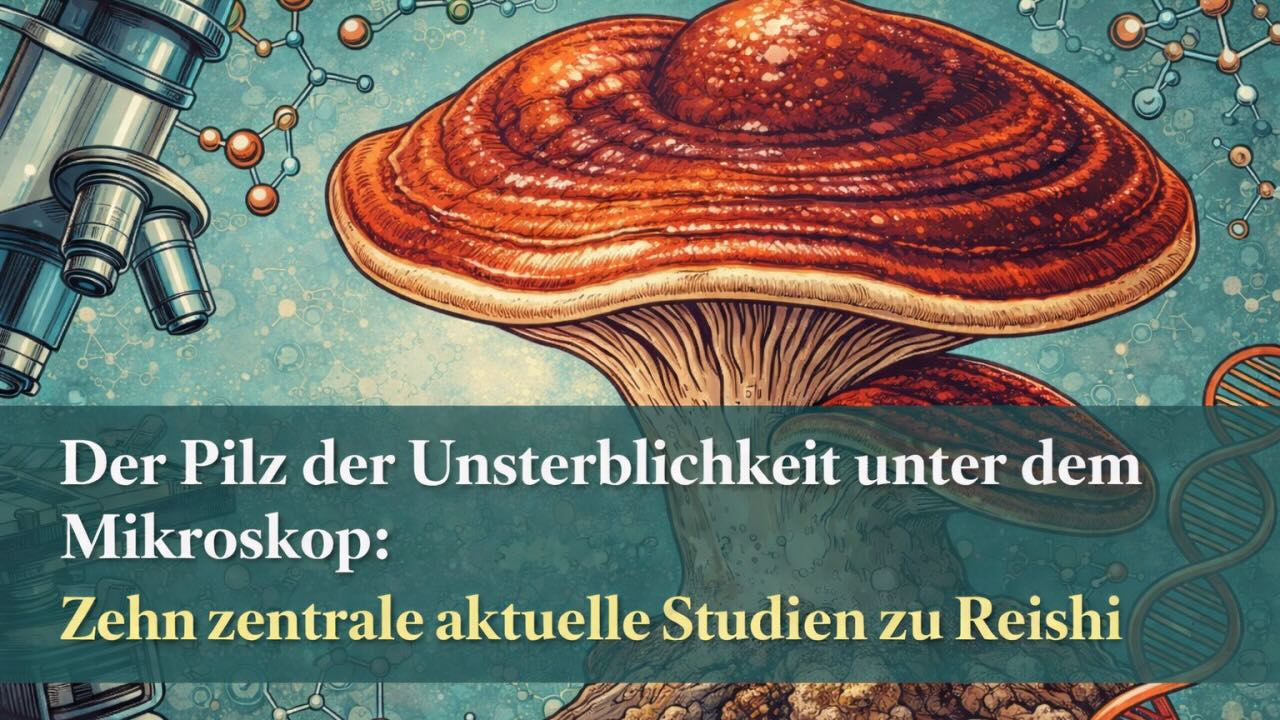
For more than two thousand years, Ganoderma lucidum —known as Lingzhi in China and Reishi in Japan—has held the highest status in traditional Asian medicine. Ancient texts called it the “mushroom of immortality” and associated it with longevity, immunity, and vitality. For most of this history, these claims were based on accumulated empirical observation, not on controlled scientific investigation. That is now changing rapidly. Over the past three years, a wave of rigorous research has begun to translate what healers intuitively knew into the precise language of molecular biology, immunology, neuroscience, and clinical medicine. Here are ten of the most significant verified current studies.
Jafari, Mardani, Mirzaei Fashtali & Arghavan — Food Science & Nutrition, June 2025
The most authoritative synthesis of clinical evidence on reishi to date is a GRADE-assessed systematic review and meta-analysis published by researchers at Shahid Beheshti University of Medical Sciences in Tehran. The pooled analysis of 17 randomized controlled trials involving 971 participants showed that supplementation with Ganoderma lucidum was associated with significant reductions in body mass index, creatinine, glutathione peroxidase, and heart rate. Subgroup analyses revealed differences in effects depending on health status, dosage, duration of intervention, age, country, sample size, and year of publication. The honest result is equally important: across the entire pooled sample, no significant effects were observed on blood pressure, fasting blood glucose, lipid profile, or liver enzymes. The GRADE assessment rated the overall quality of the evidence as very low, which is not due to negative results but rather to the methodological heterogeneity of the included studies—a finding that underscores the urgent need for larger, more standardized clinical human trials.
Ren, Liu, Sang, Lu, Gao & Chen — Food Science & Nutrition, July 2025
A comprehensive review by Chinese researchers systematically mapped the primary bioactive families of Reishi—polysaccharides, triterpenoids, peptides, proteins, and sterols—and their multifaceted pharmacological profiles. Recent advances have shown that its antitumor mechanisms extend beyond immunomodulation and include the induction of cell differentiation, the inhibition of angiogenesis, and other molecular pathways. The review is distinguished by its intellectual honesty: It acknowledges that the complex chemical composition and mechanisms of action of Reishi remain incompletely understood and that only a few isolated bioactive compounds have so far been clinically validated as superior to existing therapies. The authors call for targeted research to bridge the gap between the breadth of preclinical findings and the narrowness of current clinical validation.
PMC Review — Molecules / MDPI, October 2024
A comprehensive five-year review of research on ganoderic acids, based on studies published in PubMed and Web of Science from 2020 to 2024, documented the remarkable therapeutic breadth of the primary triterpenoid compounds in reishi. Statistical evidence shows that the main functions of ganoderic acids include anticancer, anti-inflammatory, immunomodulatory, radioprotective, anti-aging, hepatoprotective, antimicrobial, antiparasitic, neuroprotective, osteoprotective, cardioprotective, antiplatelet, and antidiabetic activities. Among the most striking recent findings was the demonstration that ganoderic acid, by modulating the ERK/MAPK signaling pathway, can alleviate chemotherapy-induced cognitive dysfunction—a burdensome side effect for many cancer patients—which is of immediate clinical relevance.
Cancemi, Caserta, Gangemi et al. — Journal of Clinical Medicine, February 2024
A detailed review article from the University of Messina systematically examined the evidence regarding the role of reishi in oncology, with a specific focus on hematological cancers. Triterpenoids such as ganoderic acid and polysaccharides, including β-D-glucans, α-D-glucans, and α-D-mannans, are the most important secondary metabolites of the medicinal mushroom Ganoderma lucidum. There is evidence supporting the efficacy of ganoderic acid in hematological malignancies; its mechanisms include stimulation of the immune response, induction of macrophage-like differentiation, activation of the MAPK signaling pathway, and induction of apoptosis. This compound was tested in 26 human cancer cell lines and demonstrated anti-proliferative activity, particularly in leukemia and lymphomas. The review also found evidence supporting the use of Reishi alongside cytostatic drugs: in 12 clinical trials, primarily involving lung cancer, co-administration improved quality of life and treatment response.
Liu et al. — Food Science & Nutrition, 2025
A systematic review from 2025, published in *Food Science & Nutrition*, focused specifically on the anticancer mechanisms of reishi’s active compounds across various tumor types. The study documented several converging pathways through which polysaccharides and triterpenoids act against cancer cells, including the induction of apoptosis, the suppression of angiogenesis, and the modulation of the tumor microenvironment. Crucially, the researchers also reported on neuroprotective alkaloids isolated from Reishi fruiting bodies: Three mercaptoterpenoids and five alkaloids from the fruiting bodies of G. lucidum exhibited significant neuroprotective properties against glutamate-induced excitotoxicity in SH-SY5Y cells, and key alkaloids demonstrated significant neuroprotective and anti-inflammatory effects. Glutamate-induced excitotoxicity is a central mechanism in Alzheimer’s disease, Parkinson’s disease, and stroke, making this finding extremely interesting for neurological research.
Qin, Fang, Zhang, Zhao, Zheng & Wang — Frontiers in Microbiology, March 2024
A comprehensive review published in *Frontiers in Microbiology* examined how reishi and its active components regulate the gut microbiota in a range of disease states. The study made it clear that modulation of the gut microbiome is a key mechanism through which reishi exerts its systemic health effects. *Ganoderma lucidum* possesses biological functions, including anticancer, anti-inflammatory, antitumor, antiviral, anti-infective, antioxidant, immunomodulatory, nervine, hepatoprotective, liver-detoxifying, antihypertensive, and antidiabetic activities, and many researchers have found that the gut microbiota is closely involved in the biological functions of the secondary metabolites of G. lucidum. The review identified that reishi polysaccharides selectively promote the growth of beneficial bacterial families—including Bifidobacteriaceae, Ruminococcaceae, and Lachnospiraceae—while suppressing pathogenic strains, with downstream effects on immune regulation, inflammation, and metabolic function.
Yao, Wang, Jiang, Yan, Huang et al. — Scientific Reports, 2021 (a well-established study, frequently cited between 2023 and 2025)
One of the most mechanistically novel and widely discussed Reishi studies in recent years is this investigation in *Scientific Reports* on the well-documented calming effects of the mushroom. The researchers identified a specific active fraction—the acidic fraction of the Reishi mycelium alcohol extract (GLAA)—and precisely traced its sleep-promoting mechanism. Administration of 25, 50, and 100 mg/kg GLAA over 28 days promoted sleep in mice treated with pentobarbital by shortening sleep latency and prolonging sleep duration. GLAA administration increased the concentration of the sleep-promoting neurotransmitter 5-hydroxytryptamine as well as the transcripts Tph2, Iptr3, and Gng13 in the sleep-regulating serotonergic synaptic pathway in the hypothalamus. It was shown that the sleep-promoting effect depends on the gut microbiota—when the gut flora was disrupted, the effect was negated—which demonstrates for the first time that the calming properties of reishi are mediated via the gut-brain axis and not through direct action on the central nervous system.
Unlocking Reishi’s Secrets — AMB Express / Springer Nature, July 2025
A 2025 laboratory study from Egypt investigated the antimicrobial, antitumor, antiviral, and antioxidant properties of a reishi water extract derived from a locally isolated strain. The results confirmed a broad spectrum of antimicrobial activity against both standard bacterial strains and clinical isolates, with zone diameters ranging from 16.1 to 38.8 mm. Polysaccharides isolated from G. lucidum exhibited significant antioxidant, anti-inflammatory, and immunomodulatory properties, primarily through the modulation of NF-κB and MAPK signaling pathways as well as the activation of the Nrf2/Keap1 axis. Triterpenoids, particularly ganoderic acids, have been shown to exert anticancer effects by inducing apoptosis via mitochondrial pathways and inhibiting metastasis through the suppression of MMP-9 and IL-8. Antiviral activity has been confirmed against herpes simplex virus-1 and human adenovirus-7, with a favorable selectivity index indicating low toxicity to healthy cells.
Exploring the Health Benefits of Ganoderma — Frontiers in Cellular and Infection Microbiology, 2025
A 2025 review article in *Frontiers in Cellular and Infection Microbiology* examined the antimicrobial mechanisms of reishi in detail and positioned the mushroom as a potentially valuable tool in the fight against global antibiotic resistance. The review documented that the antimicrobial efficacy of Reishi is not attributable to a single compound, but rather to the synergistic interaction of several bioactive classes. Recent studies have investigated its potential antiviral activity, with some evidence suggesting that Ganoderma extracts may inhibit the replication of viruses such as herpes simplex virus and influenza virus. The mechanisms through which Ganoderma exerts its antimicrobial effects include disruption of microbial cell walls, inhibition of nucleic acid synthesis, and modulation of immune responses. The review highlighted the particular relevance of this research in light of the global crisis of antimicrobial resistance, in which natural compounds with multi-target mechanisms could offer advantages that single-molecule antibiotics cannot replicate.
Lucius — Integrative and Complementary Therapies, 2025
The most recent systematic review was published in 2025 by Khara Lucius in *Integrative and Complementary Therapies* and evaluated data from human studies on cancer, immune function, antioxidant status, and cardiovascular health. Regarding safety, the review confirmed that β-glucan derived from G. lucidum has been classified by the U.S. Food and Drug Administration (FDA) as “generally recognized as safe” (GRAS). The systematic review of Ganoderma spore powder found no evidence of serious adverse effects and no abnormalities in liver or kidney function; gastrointestinal complaints are among the most commonly reported side effects. Regarding efficacy in cancer, the review found that in five randomized controlled trials involving 373 patients with a confirmed cancer diagnosis, Reishi promoted T-lymphocyte proliferation and significantly improved quality-of-life scores, while co-administration with cytostatic drugs in twelve clinical trials improved treatment response.
Taken together, these ten studies paint a coherent, increasingly credible picture. Reishi is not a simple dietary supplement, but a pharmacologically complex organism that exerts coordinated effects on immunity, cancer biology, gut microbiota, neurological function, sleep, and antimicrobial defense. Its mechanisms are diverse and synergistic, and this is precisely why isolated single-molecule pharmacology has struggled to fully explain effects that traditional medicine has described with confidence for over two millennia. The most important insight of the current era of research may be as much methodological as it is biological: understanding reishi requires systems thinking, not reductionist analysis. The mushroom that ancient China called the herb of immortality is now being studied with the finest tools modern science has to offer—and the results, though still incomplete, suggest that what traditional healers observed over centuries of clinical experience was no myth. It was medicine.
1. Jafari A., Mardani H., Mirzaei Fashtali Z., Arghavan B. The Nutritional Significance of Ganoderma lucidum for Human Health: A GRADE-Assessed Systematic Review and Meta-Analysis of Clinical Trials. Food Science & Nutrition, June 2025. DOI: 10.1002/fsn3.70423
2. Ren S., Liu H., Sang Q., Lu M., Gao Q., Chen W. A Review of Bioactive Components and Pharmacological Effects of Ganoderma lucidum. Food Science & Nutrition, July 2025. DOI: 10.1002/fsn3.70623
3. PMC Review. Research Progress on the Biological Activity of Ganoderic Acids in Ganoderma lucidum Over the Last Five Years. Molecules / MDPI, October 2024. PMC11509451
4. Cancemi G., Caserta S., Gangemi S., et al. Exploring the Therapeutic Potential of Ganoderma lucidum in Cancer. Journal of Clinical Medicine, February 2024. DOI: 10.3390/jcm13041153
5. Liu et al. Potential Active Compounds of Ganoderma lucidum and Their Anticancer Effects: A Comprehensive Review. Food Science & Nutrition, 2025. DOI: 10.1002/fsn3.70741
6. Qin X., Fang Z., Zhang J., Zhao W., Zheng N., Wang X. Regulatory Effect of Ganoderma lucidum and Its Active Components on Gut Flora in Diseases. Frontiers in Microbiology, March 2024. DOI: 10.3389/fmicb.2024.1362479
7. Yao C., Wang Z., Jiang H., Yan R., Huang Q., Wang Y. et al. Ganoderma lucidum Promotes Sleep Through a Gut Microbiota-Dependent and Serotonin-Involved Pathway in Mice. Scientific Reports, 2021. DOI: 10.1038/s41598-021-92913-6
8. El-Sherbiny G.M. et al. Unlocking Reishi’s Secrets: Nutritional and Medicinal Properties of Ganoderma lucidum Isolated from Tree Bark in Egypt. AMB Express / Springer Nature, July 2025. DOI: 10.1186/s13568-025-01905-6
9. Karunarathna S.C. et al. Exploring the Health Benefits of Ganoderma: Antimicrobial Properties. Frontiers in Cellular and Infection Microbiology, 2025. DOI: 10.3389/fcimb.2025.1535246
10. Lucius K. Clinical Evidence for the Use of the Medicinal Mushroom Ganoderma lucidum. Integrative and Complementary Therapies, 2025. DOI: 10.1089/ict.2024.56835.luc
Mycoverse Foundation
, Marktgass 11,
, 9490 Vaduz,
, Principality of Liechtenstein
Home | Vision | Projekte | Artikel | Vorstand/Beirat | Shop | Kontakt | Impressum/Datenschutz | Manage Cookie Settings