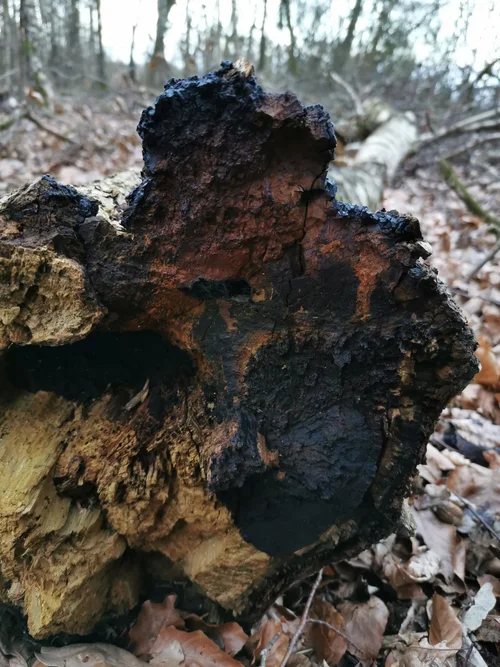
Inonotus obliquus – Clinker Polypore – Kabanoanatake – Bai Hua Rong
1. Introduction
Inonotus obliquus, besser bekannt als Chaga oder Schiefer Schillerporling, hat vor allem in Nordeurasien eine lange kultur- und medizingeschichtliche Bedeutung als traditioneller Heil- und Nutzpilz. Seine Bekanntheit beruht weniger auf kulinarischer als auf volksmedizinischer, ritueller und praktischer Nutzung. Lange Zeit wurden das schwarze, krustige Gebilde des Schiefer Schillerporlings (Inonotus obliquus) außerhalb Osteuropas kaum beachtet. Doch der legendäre Chaga-Pilz wird in Sibirien bereits seit Jahrhunderten auch bei schweren Magen-Darm-Trakt Erkrankungen verwendet und ist fester Bestandteil der Mythologie und spirituellen Tradition der indigenen Bevölkerung.
1.1. Historical and Cultural Significance
Der Pilz ist seit Jahrhunderten in Sibirien, im nördlichen Eurasien und in Teilen Ostasiens bekannt und wurde dort in der Volksmedizin verwendet. In der ostasiatischen Tradition wird Chaga ebenfalls seit langer Zeit im Umfeld der traditionellen Medizin erwähnt und genutzt.
Kulturell steht Chaga für den Umgang nördlicher und indigener Gesellschaften mit der birkenreichen Waldlandschaft. Er wurde nicht nur als Tee oder Heilmittel eingesetzt, sondern auch als Zunder zum Feuer machen und als Teil alltäglicher Waldnutzung beschrieben. In manchen Regionen galt er als wertvoller Naturrohstoff mit besonderem Platz in der Hausmedizin und im praktischen Überleben im Norden.
Chaga ist heute ein Beispiel dafür, wie ein Wildpilz von einem regionalen Volksheilmittel zu einem global bekannten „Vitalpilz“ wurde. Diese kulturelle Aufwertung ist eng mit modernen Wellness- und Supplement-Trends verbunden, die an ältere Traditionen anknüpfen. Zugleich bleibt seine historische Rolle stark mit Birkenwäldern, Winterklima und traditioneller Selbstversorgung verbunden.
Period
Region / Kultur
Category
Description
~3400 v. Chr.
Südtiroler Alpen (Ötzi)
Mythos; nicht belegt
Ötzi der Eismann trug KEINEN Chaga. Er trug Fomes fomentarius (Zunderschwamm) und Piptoporus betulinus (Birkenporling). Der Chaga-Bezug ist eine weitverbreitete Fehlinformation in Marketingmaterialien.
~2700 v. Chr. / ~100 v. Chr.
China (mythologisch)
Mythos; nicht belegt
Behauptung: Chaga sei im Shennong Bencao Jing als ‚König der Kräuter‘ verzeichnet. Tatsächlich enthält das Werk Reishi (Ganoderma lucidum) als prominenten Pilz, aber nicht Chaga. Die Behauptung stammt ausschließlich aus kommerziellen Quellen.
Vorgeschichte (undatiert)
Westsibirien – Khanty
Indigene Tradition; belegt
Die Khanty (Ob-Gebiet) nutzten Chaga als Gluttransporter, in der Volksmedizin und in der Frauenheilkunde. Das Wort ‚Chaga‘ stammt aus dem Komi-Wort tšak (= Pilz), dem Volk am Kama-Flussbecken westlich des Urals.
Vorkolonial (undatiert)
Nordamerika – Cree, Ojibway, Wet’suwet’en u.a.
Indigene Tradition; belegt
Mehrere First Nations nutzten Chaga eigenständig: Cree (Poashkan/Wiskakecakomikih), Chipewyan & Ojibway (Cha’a’ihtthi). Verwendung als Räucherwerk, Tee gegen virale Erkrankungen, Moxibustion, Gelenkschmerz-Behandlung.
~11.–12. Jahrhundert
Kiewer Rus (Osteuropa)
Volksmedizin slawisch; überliefert
Großfürst Wladimir Monomach (reg. 1113–1125) soll laut Volksüberlieferung Lippentumore durch einen Chaga-Sud geheilt haben. Frühester schriftlich überlieferter Hinweis auf Chaga als Krebsmittel in der slawischen Welt.
15.–16. Jahrhundert
Russland, Karelien, Sibirien, Baltikum, Finnland
Volksmedizin slawisch; belegt
Erste dokumentierte Anwendungen in der russischen Volksmedizin gegen Krebs, Gastritis, Ulzera, Tuberkulose und Leberleiden. Berichte aus Karelien (Region Olonez), Sibirien, Baltikum, Finnland. Zubereitungsform: stundenlanger Heißwasserextrakt (Tee).
19. Jahrhundert
Russland, Finnland
Frühe Medizin; belegt
Russische Ärzte entwickelten systematische Behandlungsmethoden mit Chaga für Magen-, Darm- und Hautkrankheiten. In Finnland als Immunstärkungsmittel und Kaffeeersatz (besonders im 2. Weltkrieg bei Kaffeemangel).
1950er Jahre
Sowjetunion (Moskau)
Wissenschaft; belegt
Moskauer Medizinisches Institut: klinische Studien zu Chaga. 1955: Russisches Gesundheitsministerium erkennt Chaga offiziell als wirksames Heilmittel an. Seitdem in Russland als rezeptfreies Apothekenpräparat erhältlich.
1968
Sowjetunion / international
Literatur / Westverbreitung; belegt
Alexander Solschenizyn (Nobelpreis 1970) beschreibt in ‚Krebsstation‘ die Chaga-Nutzung im russischen Volksalltag. Erste breite Bekanntmachung von Chaga im westlichen Ausland. Solschenizyn schrieb Chaga eine Rolle bei seiner eigenen Mundkrebsbehandlung zu.
2000er–heute
Global (Europa, Nordamerika, Asien)
Moderne; belegt
Globaler Superfood-Boom: Chaga als Tee, Kaffeezusatz (‚Chagaccino‘), Tinktur, Hautpflege. Wissenschaftliche Forschung zu Betulin, Betulinolsäure, Beta-Glucanen und Antioxidantien (Humanstudien fehlen weitgehend). Naturschutzbedenken durch Überernte in Finnland, Kanada, Baltikum.
Tabelle 1: Historische Nutzung von Chaga (Inonotus obliquus).
1.2. Brief Medical and Environmental Overview
Inonotus obliquus ist medizinisch vor allem als traditioneller Heilpilz bekannt, dem antioxidative, entzündungshemmende und immunmodulierende Eigenschaften zugeschrieben werden. Die moderne klinische Evidenz ist aber noch begrenzt und vieles stammt aus Labor- oder Traditionsanwendungen. Ökologisch ist er ein birkengebundener Holzparasit bzw. -bewohner der kalten Nordhalbkugel und spielt im Waldstoffkreislauf eine Rolle beim Abbau von Holz und der Dynamik von Birkenbeständen.
In der traditionellen russischen, ostasiatischen und volksmedizinischen Nutzung wurde Chaga unter anderem bei Magen-Darm-Beschwerden, Wunden und als allgemeines Tonikum eingesetzt. Viele Quellen betonen zusätzlich mögliche Effekte auf Immunsystem, Entzündungsprozesse und oxidativen Stress.
Ökologisch wächst Inonotus obliquus vor allem an Birken in borealen und subarktischen Regionen der Nordhalbkugel. Er ist dabei kein frei lebender Bodenpilz, sondern an seinen Wirtsbaum gebunden und bildet über Jahre die typische schwarze, harte Sklerotienform aus. Seine Präsenz ist deshalb eng mit naturnahen Birkenwäldern verbunden und kann als Teil des Holzabbaus und der Waldsukzession verstanden werden.
2. Bioaktive Inhaltsstoffe
Melanin-Glucan Complex – The UV Protector
Allomelanin – nitrogen-free complex melanin from wild mushrooms, associated with polysaccharides and proteins
UV Protection – Protects against UV radiation through DNA repair
Protection Against Toxoplasma – Liver-Protective Effects in Infected Mice
Traditional Uses – Time-Tested Medicine
Pain Management – The Traditional Pain Reliever
Rheumatic Pain – Relief for Joint Discomfort
General pain relief – Analgesic properties
Cancer Treatment – The Traditional Tumor Fighter
Various types of cancer:
Hodgkin's disease – Lymph node cancer
Rectal cancer
Lip tumors – Tumors of the oral cavity
Gastrointestinal Cancers – Digestive Tumors
Infectious Diseases – The Traditional Fighter Against Infections
Tuberculosis – Treatment of this lung disease
Worms – Antiparasitic Effect
Antibacterial – Combating bacterial infections
Gastrointestinal Health – The Traditional Digestive Aid
Gastritis – Inflammation of the stomach lining
Ulcers – Ulcer Treatment
Liver Diseases – Liver Dysfunction
General Health Promotion – The Traditional All-Rounder
Blood-purifying – Detoxifying effect
Toning – Strengthening properties
Cardiovascular Diseases – Cardiovascular Support
Metabolic Disorders – The Traditional Metabolism Regulator
Diabetes – Blood Sugar Regulation
Lipid Metabolism Disorder – Normalization of Lipid Metabolism
Wound Care – The Traditional Wound Healer
Wound Care – Promoting Wound Healing
Anti-inflammatory – Reduces inflammation
4. Referenzen
Badalyan SM, Barkhudaryan A, Rapior S. Recent advances in research on the pharmacological potential of mushrooms and prospects for their clinical application. In: Agrawal DC, Dhanasekaran M, eds. Medicinal Mushrooms [Internet]. Singapore: Springer Singapore; 2019 [cited 2021 Dec 27]. pp. 1–70. Available at: http://link.springer.com/10.1007/978-981-13-6382-5_1
Baek J, Roh H-S, Baek K-H, Lee S, Lee S, Song S-S, et al. Bioactivity-based analysis and chemical characterization of cytotoxic compounds from the Chaga mushroom (Inonotus obliquus) that induce apoptosis in human lung adenocarcinoma cells. Journal of Ethnopharmacology. October 5, 2018; 224:63–75.
Dosychev EA, Bystrova VN. [Treatment of psoriasis with preparations derived from the "Chaga" mushroom]. Vestn Dermatol Venerol. May 1973; 47(5):79–83.
Duru KC, Kovaleva EG, Danilova IG, van der Bijl P. The pharmacological potential and possible molecular mechanisms of action of Inonotus obliquus based on preclinical studies. Phytother Res. August 2019; 33(8):1966–80.
Frost, M. Three Popular Dietary Supplements Derived from Medicinal Mushrooms: An Overview of Clinical Trials in Humans. :16.
Géry, A., Dubreule, C., André, V., Rioult, J.-P., Bouchart, V., Heutte, N., & Garon, D. (2018). Chaga (Inonotus obliquus), a future potential medicinal fungus in oncology? A chemical study and a comparison of the cytotoxicity against human lung adenocarcinoma cells (A549) and human bronchial epithelial cells (BEAS-2B). Integrative Cancer Therapies, 17(3), 832–843. https://doi.org/10.1177/1534735418757912
Guthmann, J. Medicinal Mushrooms: The World’s Most Important Species: Description – Components – Effects. 2nd updated and expanded edition. Wiebelsheim: Quelle & Meyer Verlag; 2021. 446 pp.
Haertel B, Rimböck M, Neuerer T. Medicinal Mushrooms: Modulating, Restorative, and Strengthening. Salzburg: Druckerei Roser GmbH; 2019.
Han Y, Nan S, Fan J, Chen Q, Zhang Y. Inonotus obliquus polysaccharides protect against Alzheimer’s disease by regulating Nrf2 signaling and exerting antioxidant and antiapoptotic effects. International Journal of Biological Macromolecules. June 15, 2019;131:769–78.
Kimmerer, R. W. (2013). Braiding sweetgrass: Indigenous wisdom, scientific knowledge and the teachings of plants. Milkweed Editions.
Lee W, Fujihashi A, Govindarajulu M, Ramesh S, Deruiter J, Majrashi M, et al. The role of fungi in neurodegenerative diseases. In: Agrawal DC, Dhanasekaran M, eds. Medicinal Mushrooms [Internet]. Singapore: Springer Singapore; 2019 [cited 2021 Dec 27]. pp. 223–49. Available from: http://link.springer.com/10.1007/978-981-13-6382-5_8
Lemieszek, M. K., & Rzeski, W. (2012). Anticancer properties of polysaccharides isolated from fungi of the Basidiomycota class. Contemporary Oncology, 16(4), 285–289. https://doi.org/10.5114/wo.2012.30055
Lu Y, Jia Y, Xue Z, Li N, Liu J, Chen H. Recent developments in polysaccharides from Inonotus obliquus (Chaga mushroom): isolation, structural properties, biological activities, and applications. Polymers. January 2021; 13(9):1441.
Martin Powell. Medicinal Mushrooms. [Internet]. Place of publication not identified: Mycology Press; [cited December 27, 2021]. Available at: https://www.hoopladigital.com/title/11571096
McCallum NC, Son FA, Clemons TD, Weigand SJ, Gnanasekaran K, Battistella C, et al. Allomelanin: A biopolymer with intrinsic microporosity. J Am Chem Soc. March 17, 2021;143(10):4005–16.
Najafzadeh M, Reynolds PD, Baumgartner A, Jerwood D, Anderson D. Chaga-Pilzextrakt hemmt oxidative DNA-Schäden in Lymphozyten von Patienten mit entzündlichen Darmerkrankungen. Biofactors. 2007;31(3–4):191–200
Nowakowski P, Markiewicz-Żukowska R, Bielecka J, Mielcarek K, Grabia M, Socha K. Treasures from the Forest: Evaluation of Mushroom Extracts as Anti-Cancer Agents. Biomed Pharmacother. November 2021;143:112106.
Pradeep P, Manju V, Ahsan MF. Antiviral efficacy of fungal components. In: Agrawal DC, Dhanasekaran M, eds. Medicinal Mushrooms [Internet]. Singapore: Springer Singapore; 2019 [cited 2021 Dec 27]. pp. 275–97. Available from: http://link.springer.com/10.1007/978-981-13-6382-5_10
Rebensburg, P., & Kappl, A. Healthy with Medicinal Mushrooms: Strengthening the Immune System, Healing Illnesses, and Relieving Symptoms. Munich: riva; 2020. 271 pp.
Rogers, RD. The Mushroom Pharmacy: The Complete Guide to Medicinal Mushrooms and Lichens of North America. Berkeley, California: North Atlantic Books; 2011. 591 pp.
Shashkina MYa, Shashkin PN, Sergeev AV. Chemical and biomedical properties of chaga (review). Pharm Chem J. October 2006; 40(10):560–8.
Stajić M, Vukojević J, Ćilerdžić J. Mushrooms as potential natural cytostatic agents. In: Agrawal DC, Dhanasekaran M, eds. Medicinal Mushrooms [Internet]. Singapore: Springer Singapore; 2019 [cited 2021 Dec 27]. pp. 143–68. Available from: http://link.springer.com/10.1007/978-981-13-6382-5_4
Stojkovic D, Smiljkovic M, Ciric A, Glamoclija J, Van Griensven L, Ferreira ICFR, et al. An insight into the antidiabetic properties of six medicinal and edible mushrooms: inhibition of α-amylase and α-glucosidase in the context of type 2 diabetes. South African Journal of Botany. January 1, 2019;120:100–3.
Su B, Yan X, Li Y, Zhang J, Xia X. Effects of Inonotus obliquus polysaccharides on the proliferation, invasion, migration, and apoptosis of osteosarcoma cells. Alhosin M, Editor. Analytical Cellular Pathology. November 17, 2020; 2020:1–7.
Szychowski KA, Skóra B, Pomianek T, Gmiński J. Inonotus obliquus – from folk medicine to clinical use. J Tradit Complement Med. August 22, 2020;11(4):293–302.
Tee, P. Y. E., Tang, Y. Q., Fung, S. Y., & Chia, A. Y. Y. (2023). Therapeutic properties of Inonotus obliquus (Chaga mushroom): A review. Mycology, 14(4), 1–18. https://doi.org/10.1080/21501203.2023.2260408
Wang C, Li W, Chen Z, Gao X, Yuan G, Pan Y, et al. Effects of simulated in vitro gastrointestinal digestion on the chemical properties, antioxidant activity, and α-amylase and α-glucosidase inhibitory activity of polysaccharides from Inonotus obliquus. Food Research International. January 1, 2018;103:280–8.
Wold CW, Gerwick WH, Wangensteen H, Inngjerdingen KT. Bioactive triterpenoids and water-soluble melanin from Inonotus obliquus (Chaga) with immunomodulatory effects. Journal of Functional Foods. August 2020; 71:104025.
Wong JH, Ng TB, Chan HHL, Liu Q, Man GCW, Zhang CZ, et al. Fungal extracts and compounds with inhibitory effects on breast cancer: findings from studies using cultured cancer cells, tumor-bearing animals, and clinical trials. Appl Microbiol Biotechnol. June 2020; 104(11):4675–703.
Zhang C-J, Guo J-Y, Cheng H, Li L, Liu Y, Shi Y, et al. Spatial structure and anti-fatigue effects of polysaccharides from Inonotus obliquus. Int J Biol Macromol. May 15, 2020; 151:855–60.
Zhao Y, Zheng W. Unraveling the antitumor potential of bioactive metabolites from the medicinal mushroom Inonotus obliquus. J Ethnopharmacol. January 30, 2021; 265:113321.
Sign up for our newsletter. No spam, no sharing of your information—just the latest news and interesting facts from the world of mushrooms. You can unsubscribe at any time.
Mycoverse Foundation , Marktgass 11, , 9490 Vaduz, , Principality of Liechtenstein