
Pleurotus ostreatus – Oyster Mushroom – Hiratake – Ping Gu
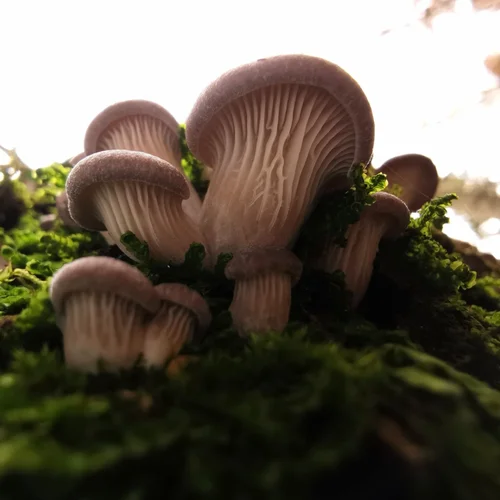
Der Austernpilz (Pleurotus ostreatus) zählt zu den bedeutendsten Speise- und Heilpilzen weltweit. Er ist die Vitaminbombe unter den Vitalpilzen und seine bemerkenswerten bioaktiven Eigenschaften machen ihn zu einem der am besten erforschten Vitalpilze für therapeutische Anwendungen.
Oyster mushrooms have been mentioned in herbal books since the 16th century and have been cultivated for about 100 years. Oyster mushrooms are found almost everywhere in the world in temperate and subtropical forests; they are most commonly found on deadwood or on stumps of various deciduous trees. Their distinctive growth form, reminiscent of an oyster, gives them their name—the Greek terms “pleurón” (rib, side of the body) and “oús” or “otós” (ear) refer to the ear-shaped fruiting bodies with stems attached to the sides. “Ostreatus” comes from Latin and means “resembling an oyster shell.”
There are about 30 different species of Pleurotusworldwide, along with numerous varieties. All species share a fairly large, fleshy cap. They usually grow in clusters but can also appear singly. A short stem is often barely visible and is located on the side of the cap’s edge. The color spectrum ranges from white and gray to yellow (Pleurotus citrinolileatus), steel blue (Pleurotus columbinus), and violet (Pleurotus djamor), with some oyster mushroom species even appearing nearly black. The flesh of young specimens is tender, mild in flavor, and characterized by a pleasant aroma.
Mushrooms are generally considered to bring good luck in Asia, and the oyster mushroom is no exception. In China, Japan, and Korea, it is a traditional edible mushroom and symbolizes health, longevity, and prosperity. In Traditional Chinese Medicine (TCM), it is known for its fortifying effects; here, it is used to strengthen the venous system and treat muscle and tendon complaints, as well as lower back pain, lumbago, stiffness in the limbs, and to promote blood formation.
In China, Pleurotus was already praised in a poem during the Song Dynasty (960–1279). During the Ming Dynasty (1368–1644), it was mentioned in several writings. However, it is likely that Ping Gu (Chinese oyster mushroom) was used as food and as a remedy in folk medicine much earlier.
In Europe, it did not gain prominence until the 20th century as a protein-rich meat substitute in vegetarian and vegan cuisine, and is considered a gourmet mushroom in fine dining. The oyster mushroom is an early example of organized and professional mushroom cultivation in Europe.
| Period | Meaning |
| Before 1897 | Wild-harvested, regional edible mushroom |
| 1897 | First breeding experiments in France |
| 1915–1945 | An important food substitute in times of need; specifically bred to thrive on straw and wood in Central Europe |
| From 1950 | An economically important cultivated mushroom; a pioneer in European mushroom cultivation |
| 1960s | Cultivation on straw (Hungary) |
| Today | A symbol of sustainability and plant-based nutrition |
The oyster mushroom has historically played an important role as a food source during times of crisis, such as wartime and famine relief, as well as in modern mushroom cultivation. It grows mainly in late fall and winter and was once considered an “insider’s tip” among mushroom foragers. Today, it is considered resource-efficient because it grows well on wood, straw, or coffee grounds, and it also plays a significant role in the circular economy by efficiently utilizing organic waste. Alongside the button mushroom and the shiitake, it is one of the most commonly cultivated edible mushrooms worldwide.
The oyster mushroom is now also associated with innovation, as it is used in mycoremediation, and its mycelium can be used to produce various materials such as biodegradable packaging, insulation panels, and other eco-friendly building materials.
Relevance in modern mycotherapy:
The main areas of application are metabolism, the musculoskeletal system, chronic inflammation, and nerve degeneration.
Relevance in ecology:
Pleurotus ostreatus is a widespread, cold-tolerant wood-decaying fungus that grows on deadwood or stumps of various deciduous trees. It is a typical wound and weakened-tree parasite, meaning it prefers to colonize weakened (diseased) or injured but still living trees. Oyster mushrooms are also important saprobionts (secondary decomposers), meaning they can also grow on dead trees or fallen wood. In the wood they colonize, they break down lignin and cellulose, which leads to a whitening of the wood (so-called white rot). Through these processes, Pleurotus ostreatus contributes significantly to humus formation, nutrient recycling, and the stabilization of forest ecosystems.
| CATEGORIES | TAXA |
| DOMAIN (Region) | EUKARYA |
| REICH (Regnum) | FUNGI |
| PHYLUM | BASIDIOMYCOTA (basidiomycetes) |
| CLASS (Classis) | AGARICOMYCETES |
| ORDER (Ordo) | AGARICALES (sheet fungi) |
| FAMILY (Familia) | PLEUROTACEAE (Oyster mushroom family) |
| GENUS | Oyster mushroom |
| ART (Species) | Pleurotus ostreatus (oyster mushroom) |
Pleurotus ostreatus was first scientifically described in 1775 by the Dutch naturalist Nicolaus Joseph von Jacquin; the name Pleurotus ostreatus , which is still in use today, was later assigned by Paul Kummer (1871). Kummer reclassified many sheet-like mushrooms and introduced the genus Pleurotus, to which the oyster mushroom still belongs today.
Synonyms: oyster mushroom, veal mushroom, oak mushroom, shell mushroom, oyster side mushroom, oyster sponge, oyster twirler, beech sponge, twirler, abalone mushroom
Taxonomic synonyms: Agaricus ostreatus (originally described in the 18th century). Over the course of its taxonomic history, the species has been renamed several times. Important scientific (historical) synonyms include:
In the 18th and early 19th centuries, many oyster mushrooms were initially classified under the large, umbrella genus Agaricus. Later, they were divided into smaller genera that are recognized today, such as Pleurotus.
The genus Pleurotus was formerly classified within thePolyporaceae family, but is now classified within thePleurotaceae family. The classification of the genus and the species boundaries of some of its representatives are still the subject of controversy among mycologists. Many excellent edible mushrooms, which are now cultivated worldwide, belong to the genus Pleurotus . Globally, there are about 30 species in the genus, of which about eight occur wild in Europe. These include the spruce oyster mushroom (Pleurotus calyptratus), the horned oyster mushroom (Pleurotus cornucopiae), the ringed oyster mushroom (Pleurotus dryinus), the herb oyster mushroom (Pleurotus eryngii), the pale herb oyster mushroom (Pleurotus nebrodensis), the Opuntia oyster mushroom (Pleurotus opuntiae), the oyster mushroom (Pleurotus ostreatus), and the lung or summer oyster mushroom (Pleurotus pulmonarius).
King oyster mushrooms have a fleshy cap shaped like an oyster, a shell, or a tongue. The light-colored gills are located on the underside of the cap and usually extend a long way down the stem. These mushrooms, which have short or no stems, grow laterally on the substrate, and their spore print is white. As opportunistic parasites and saprophytes, these species meet their nutritional needs primarily on deciduous trees. These mushrooms are capable of breaking down cellulose and lignin, which leads to what is known as white rot in wood. The king oyster mushroom is an exception here, as it does not grow parasitically on wood in the wild but rather on the roots of certain umbelliferous plants.
The oyster mushroom can be distinguished from similar species by its season, color, odor, spore print, and substrate.
Pleurotus pulmonarius (summer oyster mushroom):
Pleurotus eryngii ( king oyster mushroom):
Pleurotus cornucopiae (horned oyster mushroom):
Pleurocybella porrigens (Angel's Wings; poisonous):
Hohenbuehelia petaloides (Shellflower):
Key identifying characteristics of Pleurotus ostreatus (oyster mushroom):
The oyster mushroom typically grows in fan-shaped clusters, usually close to the host tree. The stem is short (2–4 cm), sometimes absent, and is usually offset from the center of the cap toward the edge. It is often covered with a mycelial felt at the base. The stem’s color ranges from pale creamy-beige to whitish. The coloration of the fruiting bodies varies to a greater or lesser extent. It often changes with age and also depends on growing conditions (temperature, light exposure). The fruiting body can be found in a wide variety of brown tones and all shades of gray to silvery, and even violet hues. Once spore maturity is reached, the often decorative colors of young oyster mushrooms fade to gray-brown or light gray tones. The fading of the cap color due to water loss (hygrophanity) is an important characteristic and relevant for the correct identification of many mushroom species. The fruiting bodies of the oyster mushroom fade mainly from the edge (centripetal), but also in streaks. It should be noted here that, due to this fading with age, most cultivated varieties of the oyster mushroom exhibit lighter shades so that the layperson cannot tell how old the mushrooms already are. This allows for a longer sales period for the cultivated mushrooms.
The cap surface is smooth, bare, and slightly glossy when moist, and can reach a diameter of 2 cm to 25 cm. In young specimens, the cap margin is curved downward; in older ones, it is slightly wavy and torn, as it curves further upward as the mushroom grows, resulting in the typical shell shape. A white coating often forms on the cap surface as the mushroom grows; this is fungal mycelium.
The gills of Pleurotus ostreatus are mostly forked and extend noticeably far down the stem (at least one-third of the way down), and may continue in the form of fine lines all the way to the base of the stem. The gills are pale creamy-white in color, turning yellowish later on. The edges of the gills are wavy and slightly notched.
The spore powder is whitish in color, but may have a slight violet tint.
The juicy flesh of fresh oyster mushrooms is white to creamy white or grayish white, radially fibrous, and becomes increasingly tough toward the stem. In older specimens, the flesh may become somewhat tough.
Oyster mushrooms have a pleasantly earthy, mushroomy aroma and a mushroomy, slightly nutty flavor. However, you should avoid eating them raw, as this species contains hemolysins (substances that break down blood). Older, spoiled specimens have a rotten or musty smell and should not be consumed. Nevertheless, oyster mushrooms do not cause pseudo-mushroom poisoning (gastrointestinal symptoms caused by consuming spoiled mushrooms), as the mushroom’s antibiotic-like compounds keep bacterial growth in check.
| Mushroom part | Form | Color |
| Hat | Smooth, bare, 2–20 (up to 25) cm, shell- or oyster-shaped; rolled edge (when young) | Creamy ochre to light brown, grayish, sometimes silvery to violet |
| stem | Short, thick, or missing; growing from the side of the cap | Pale creamy beige to whitish |
| slats | Extending far down, but not to the base of the stem; wavy and slightly notched | Pale creamy-white, later yellowish |
| Meat | White to cream-white | |
| Spurs | White to light purple |
The scent profile can also be used to reliably identify the oyster mushroom, although scents are perceived very subjectively. Fresh, undamaged fruiting bodies have a faint mushroomy scent or a pleasant, mild anise-like aroma, which is also often described as mildly sweet. If the gills are squeezed between the fingers, the oxidation of metabolites produces a sour, mealy note (distinguishing it from Pleurotus pulmonarius, which smells less mealy but more strongly of anise). Older specimens have a musty, sour, or unpleasant odor due to decomposition processes.
In macrochemistry, Pleurotus ostreatus usually shows no reaction or only a weak one. Oyster mushrooms lack characteristic pigments such as indole derivatives or quinones. Sulvanillin produces a reddish reaction in oyster mushrooms, and the weakly amyloid spores can be stained purple-gray under a microscope using Melzer’s reagent.
Zur genauen Identifikation in der Mykologie und Biochemie weist der Austernpilz spezifische chemische Marker auf:
Diese Marker ermöglichen Analysen per GC-MS oder LC-MS und unterscheiden Pleurotus ostreatus von nahen Verwandten.
The oyster mushroom is found in temperate and subtropical forests worldwide. A cosmopolitan mushroom that grows in many climate zones across Europe, Asia, Africa, South America, and parts of North America. However, it is absent from the Pacific Northwest of North America, where Pleurotus populinus (poplar oyster mushroom) and Pleurotus pulmonarius ( lung oyster mushroom)—which is also native to our region—are found instead. In Central Europe, its peak season runs from November through mid-March, though fresh fruiting bodies can be found well into spring. Oyster mushrooms prefer high humidity and cold temperatures. They only thrive below 11°C and are therefore considered a typical winter mushroom. Optimal conditions for growth include light night frosts, temperatures between zero and ten degrees, heavy precipitation, or at least sufficient moisture. During prolonged frost and dry air, growth pauses and no new fruiting bodies are formed. The mushroom has a particularly deep connection to the cold—in the spring of 2023, it was discovered that oyster mushrooms are up to 6°C cooler than the ambient temperature. This cooling is caused by evaporative cooling and affects not only the visible fruiting bodies but also extends to the mycelium. Presumably, the cooling promotes a microclimate that generates air currents and aids in spore dispersal.
In Central Europe, this mushroom can be found from sea level up to the higher elevations of the Alps. When searching for fresh oyster mushrooms, it is best to look for extensively managed areas with old deciduous trees (forests, riparian forests, parks). Oyster mushrooms colonize living and dead hardwood trunks and stumps such as birch, ash, alder, linden, oak (rarely), and even fruit trees (apple, pear), with European beech (Fagus sylvatica), poplar (Populus spp .), and willow (Salix spp .) being the preferred hosts. It is very rarely found on coniferous wood. On colonized trees, it often fruits over several years, even high up on the trunk or on the branches.
Pleurotus ostreatus is ecologically significant as a decomposer and fulfills several key roles as a saprophyte, wound parasite, and opportunistic parasite in forest ecosystems. In the forest, it acts as a “health police”: weak and diseased trees are specifically targeted. The mycelium penetrates through wounds and colonizes the sapwood and heartwood of the infested tree. As a primary decomposer, it produces laccases, peroxidases, and cellulases—enzymes that break down lignin and cellulose. Initially, the wood becomes brittle and later soft, turning whitish to gray (so-called white rot). Enzymatic decomposition releases potassium, phosphorus, nitrogen, and trace elements (especially Cu and Zn), which enter the soil and in turn sustainably promote plant growth and humus formation. Pleurotus ostreatus is a potentially carnivorous fungus; because it grows on nutrient-poor wood, it paralyzes and digests nematodes to obtain additional nitrogen. In doing so, the mycelium forms lollipop-shaped toxocysts (round hyphal extensions with spines) that release the nerve gas 3-octanone, a volatile organic compound. As soon as a nematode touches these cysts, they burst and release the gas. This paralyzes the prey; the hyphae then penetrate, colonize, and digest the worm extracellularly, recycling nitrogen (up to 40% of the requirement). Agricultural trials for the biological control of nematodes are already underway. The use of oyster mushrooms in open fields leads to nearly complete elimination of the pests, with the fungus specifically targeting plant-damaging nematodes while sparing beneficial soil organisms.
However, some of the enzymes produced by the fungus are also capable of breaking down other organic compounds and hydrocarbons. In modern environmental engineering, efforts are being made to harness these properties, for example, to remediate soil contaminated with waste oil or other harmful chemicals.
Another interesting property of the oyster mushroom is its ability to adsorb heavy metals such as cadmium, mercury, manganese, chromium, etc. This adsorption is reversible, meaning that corresponding purification systems could be regenerated and used, for example, to treat contaminated wastewater.
The oyster mushroom's ecological efficiency makes it a model organism for sustainable biotechnology. Typical values range from 55% to 87% on straw and up to 70% on hardwood, and in biogas plants it can increase yields by up to 43%.
Pleurotus ostreatus ist die Vitaminbombe unter den Vitalpilzen und enthält eine Vielzahl bioaktiver Verbindungen. Bisher wurden mehrere hundert (wahrscheinlich sogar mehr als 1000) davon identifiziert und es gibt mehr als 25.000 wissenschaftliche medizinische Studien zum Austernseitling. Die Quantität der bioaktiven Verbindungen in Pilzen ist stark abhängig vom Milieu in dem die Pilze wachsen, auch zeigen sich Unterschiede in Myzel und Fruchtkörper, weiters sind die einzelnen Extraktionsverfahren und Analysemethoden ausschlaggebend.
Like most mushrooms, oyster mushrooms consist largely of water (about 90%). When water is removed from an organism through drying, what remains is known as dry matter (DM). In terms of dry matter, oyster mushrooms contain:
Der Austernpilz ist reich an Vitamin A, D, E und Vitamin K1, weiters gehört er zu einer kleinen Gruppe von Pilzen, die auch Vitamin C in nennenswerten Mengen enthalten (ca. 100mg/100g TM). Das ebenfalls in erwähnenswerten Mengen vorkommende Ergosterol (124-469mg/100g TM) ist eine Vorstufe des Vitamin D2, es wirkt antioxidativ, fördert das Wachstum von Knochen und Knorpeln und kann zur Vorbeugung von Osteoporose beitragen. Die Umwandlung von Ergosterol in Vitamin D2 erfolgt teilweise im Pilz selbst, dieser Vorgang lässt sich durch UV-Bestrahlung (Sonnenlicht) erheblich steigern.
Weiters ist der Austernseitling eine gute Quelle für alle acht lebensnotwendigen B-Vitamine (siehe Tabelle 4). Er weist einen außergewöhnlich hohen Gehalt an Folsäure (B9; 65 mg/100g TM) auf, die eine wichtige Rolle bei der Blutbildung und Zellerneuerung spielt.
| B vitamin | % RDA* per 100 g of fresh mushrooms |
| Thiamine (B1) | 20 |
| Riboflavin (B2) | 40 |
| Niacin (B3) | 40 |
| Pantothenic acid (B5) | 20 |
| Pyridoxin (B6) | 40 |
| Biotin (B7) | 30 |
| Folic acid (B9) | 100 |
Der Gehalt an den Vitaminen B7, B9 und K1 ist sogar der höchste unter allen gängigen Vitalpilzen. Zusätzlich ist Pleurotus ostreatus reich an Mineralstoffen wie Kalium, Eisen, Magnesium, Kalzium, Natrium und Phosphor sowie die Spurenelemente Kupfer und Zink. Darüber hinaus enthält Pleurotus ostreatus eine beachtliche Menge an Proteinen, darunter Lektine und Enzyme, sowie alle essenziellen und nicht essenziellen Aminosäuren. Außerdem enthält der Fruchtkörper von Pleurotus ostreatus nach Agaricus blazei Murrill (Mandelpilz) die zweithöchste Menge an Gamma-Aminobuttersäure (GABA). GABA ist der wichtigste inhibitorische Neurotransmitter im Zentralnervensystem, durch sie entsteht ein Gleichgewicht zwischen neuronaler Erregung und Hemmung, sie reduziert Stress und fördert den Schlaf.
Lovastatin (Mevinolin)
A natural statin with cholesterol-lowering effects; it regulates VLDL levels and stimulates antioxidant enzymes such as superoxide dismutase, catalase, and glutathione peroxidase.
Pleuran
Highly active β-glucan with proven antitumor, anti-inflammatory, antioxidant, and immunostimulatory effects.
Ostreatin
Ribotoxin-ähnliches Protein, das spezifisch ribosomale RNA spaltet und die Proteinsynthese hemmt, somit wirkt es zytotoxisch und ist potentiell krebshemmend.
Pleurotus ostreatus enthält außergewöhnlich hohe Konzentrationen an:
Diese Polysaccharide erklären viele gesundheitsfördernde Effekte des Austernseitlings, von Immunmodulation bis Antioxidation. Der Gehalt variiert stark je nach Extraktionsmethode, verwendete Pilzteile und Anbau (bis 30% Trockenmasse).
Pleurotus ostreatus wird pharmazeutisch als Vitalpilz-Droge definiert, bestehend aus getrockneten und pulverisierten Fruchtkörpern (Kapseln, Tabletten) oder standardisierten Extrakten (Myzel und/oder Fruchtkörper). Die Droge umfasst bioaktive Fraktionen wie Polysaccharide (β-Glucane), Statine (Lovastatin) und Phenole für immunmodulatorische und cholesterinsenkende Zwecke. Wichtige Spezifikationen und Analyseverfahren des Mykotherapeutikums sind in Tabelle 6 aufgelistet.
| Inhaltsstoff | Wirkung | Extraktion | Primärmethoden | Detektion |
| Polysaccharide (β-Glucane), Pleuran) | Immunstimulation, Antitumor | Wasser/Alkali | SEC/HPLC/ Enzymatisch | RI/UV/Enzymatisch |
| Statine (Lovastatin) | Cholesterinsenkend | Methanol | HPLC/LC-MS | DAD/MS (238 nm) |
| Proteine | Essentielle Aminosäuren | Hydrolyse | BCA/HPLC | UV/Fluoreszenz |
| Vitamine (B, C, D) | Antioxidativ, Energiestoffwechsel | Wasser/ organisch | HPLC | UV/Fluoreszenz |
| Ergothionein | Starkes Antioxidans | Wasser | HPLC-MS/UPLC | MS/Fluoreszenz (254/420 nm) |
| GABA | Beruhigend, Blutdrucksenkend | Wasser/ Derivatisierung | HPLC-FLD/LC-MS | Fluoreszenz/MS |
| Phenole | Antioxidativ | Ethanol/ Methanol | Folin-Ciocalteu/HPLC | 760/280 nm (3200 cm-1) |
Die Analyse der wichtigsten bioaktiven Inhaltsstoffe in Vitalpilzprodukten sichert deren Qualität und Wirksamkeit. Es werden typischerweise mehrere Analyseverfahren kombiniert, weil „Polysaccharide“ allein noch nichts über echte Pilzqualität aussagen. Wichtig sind vor allem Identitäts-, Wirkstoff- und Kontaminantenanalysen.
FTIR-Spektroskopie (Fourier-Transform-Infrarotspektroskopie) ist eine vielseitige Methode für die qualitative und semi-quantitative Analyse bioaktiver Stoffe in Pilzprodukten wie Pleurotus ostreatus. Sie dient als schneller Fingerprint-Test und eignet sich für Chargenkontrolle, Myzel-Identifikation oder Extraktionsüberwachung, während HPLC/LC-MS präzise Quantifizierung liefert.
Fortsetzung folgt
Special feature: Unlike synthetic statins, lovastatin derived from oyster mushrooms can be safely used by people with alcoholism, liver disease, and during pregnancy.
Antitumor activity has been demonstrated against:
Viral infections:
Bacterial infections: Broad-spectrum activity against Staphylococcus aureus, E. coli, Pseudomonas aeruginosa, Candida albicans, and Helicobacter pylori.
Parasitic infections: Efficacy against the pathogens causing malaria, leishmaniasis, and Chagas disease.
In der Traditionellen Chinesischen Medizin (TCM) wird der Austernpilz seit Jahrhunderten geschätzt:
Allergic reactions: About 10% of the North American and European populations have allergic reactions to oyster mushroom spores, particularly in cases of occupational exposure.
Pleurotolysin: This natural ingredient can be toxic when administered intravenously—there are no concerns when taken orally as directed.
The oyster mushroom combines culinary delight with exceptional health-promoting properties and is one of the most promising medicinal mushrooms in modern naturopathy.
Mycoverse Foundation
, Marktgass 11,
, 9490 Vaduz,
, Principality of Liechtenstein
Home | Vision | Projekte | Artikel | Vorstand/Beirat | Shop | Kontakt | Impressum/Datenschutz | Manage Cookie Settings