
Journalist and regional development specialist
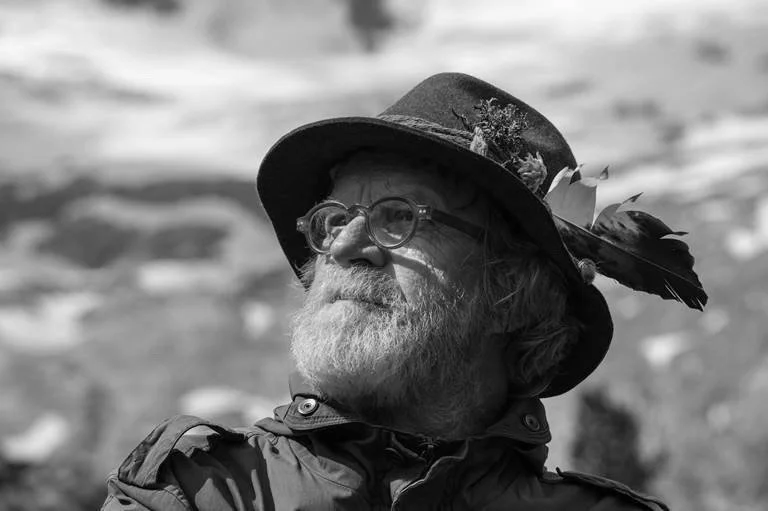
“A true connection with nature does not come from observing it from a distance—it comes from actively preserving and experiencing it. The alpine pastures, mountain meadows, and ancient sacred sites of the Alps tell us stories about sustainable ways of life and the deep relationship between humans and nature, which we must preserve for the future.”
This conviction shapes the work of Ewald Kräutler—a journalist, regional developer, and author who is now regarded as one of the leading experts on Alpine cultural landscapes, prehistoric sacred sites, and sustainable regional development in Tyrol. Through his successful initiative “Almschule im Valsertal” (founded in 2015), his book “50 Things Every Tyrolean Must Do,” and his sustainable tourism projects such as the Ötzidorf, he has elevated the themes of cultural heritage preservation and sustainable development to a level that is both practically effective and socially relevant.
From an early age, he developed a passion for understanding how Alpine cultural landscapes, prehistoric sites, and traditional ways of life can be preserved. His career as a regional developer in the Ötztal Valley was built on this vision, where, between 1996 and 2005, he developed numerous tourism-based sustainable projects, including the Ötzidorf and the reconstruction of the ore processing facility, including a miner’s house in the Wörgetal Valley. For decades, he has been intensively engaged in the study of prehistoric sacred sites, cup-marked stones, menhirs, and stone circles in Tyrol. Through his friendship with folklorist Professor Hans Haid, he became acquainted with the world of mountain farmers and deepened his understanding of traditional Alpine ways of life and their ecological significance.
In his professional work, he focuses on the preservation of Alpine cultural landscapes and the promotion of sustainable regional development. In 2015, he and some friends founded the “Almschule im Valsertal”—a nonprofit initiative that encourages volunteers to work toward preserving the cultural heritage of the Alps, particularly the alpine pastures and mountain meadows. He works with volunteers, mountain farmers, and those interested in culture to share knowledge about traditional Alpine farming practices and their importance for biodiversity. In doing so, he places great emphasis on hands-on engagement and the connection between cultural heritage and ecological responsibility.
A central focus of his work is the preservation of Alpine cultural landscapes through active participation and community engagement. Through his journalistic and literary work, he focuses on sustainable regional development, prehistoric cultural sites, and the documentation of Alpine traditions.
Currently, his work focuses on successfully continuing the Alpine School in the Valsertal Valley and documenting his findings. After retiring, he began writing blogs, including on his own platform “Tirol isch toll” and occasionally for the Innsbruck Tourism blog portal. His book “50 Things a Tyrolean Must Have Done” is essentially a condensed version of his blog portal and makes Alpine culture accessible to a wide audience. Since 2000, he has undertaken “cultural long-distance hikes”—also known as “pilgrimages”—almost every year through Portugal, Spain, France, Switzerland, and Tyrol, which he has documented in numerous personal blogs.
He knows how to combine cultural heritage with ecological responsibility and advocates for an inclusive approach to regional development—as an interplay of tradition, sustainability, and community engagement. His work makes it clear that, for him, Alpine cultural landscapes are not merely historical relics, but living systems that must be preserved for future generations through active conservation and sustainable management. At the Mycoverse Foundation, he contributes his expertise in alpine ecology, sustainable regional development, cultural heritage preservation, and the connection between traditional ways of life and biodiversity, helping to deepen understanding of the role of fungi in alpine ecosystems—and to underscore the importance of preserving these habitats for mycological diversity.
His decades of experience with alpine landscapes, his knowledge of traditional land management practices, and his practical approach to cultural heritage preservation make him a valuable consultant for projects that address the intersection of mycological research, alpine ecology, and sustainable land use. In this way, he makes a significant contribution to a future that unites cultural heritage, ecological responsibility, and active commitment to the preservation of Alpine habitats.
Mycoverse Foundation
, Marktgass 11,
, 9490 Vaduz,
, Principality of Liechtenstein
Home | Vision | Projekte | Artikel | Vorstand/Beirat | Shop | Kontakt | Impressum/Datenschutz | Manage Cookie Settings