
Hericium erinaceus (Lion’s Mane) is both an edible mushroom, a traditionally used medicinal mushroom, and a modern “functional food” with a strong marketing narrative centered on the brain, nerves, and mood.
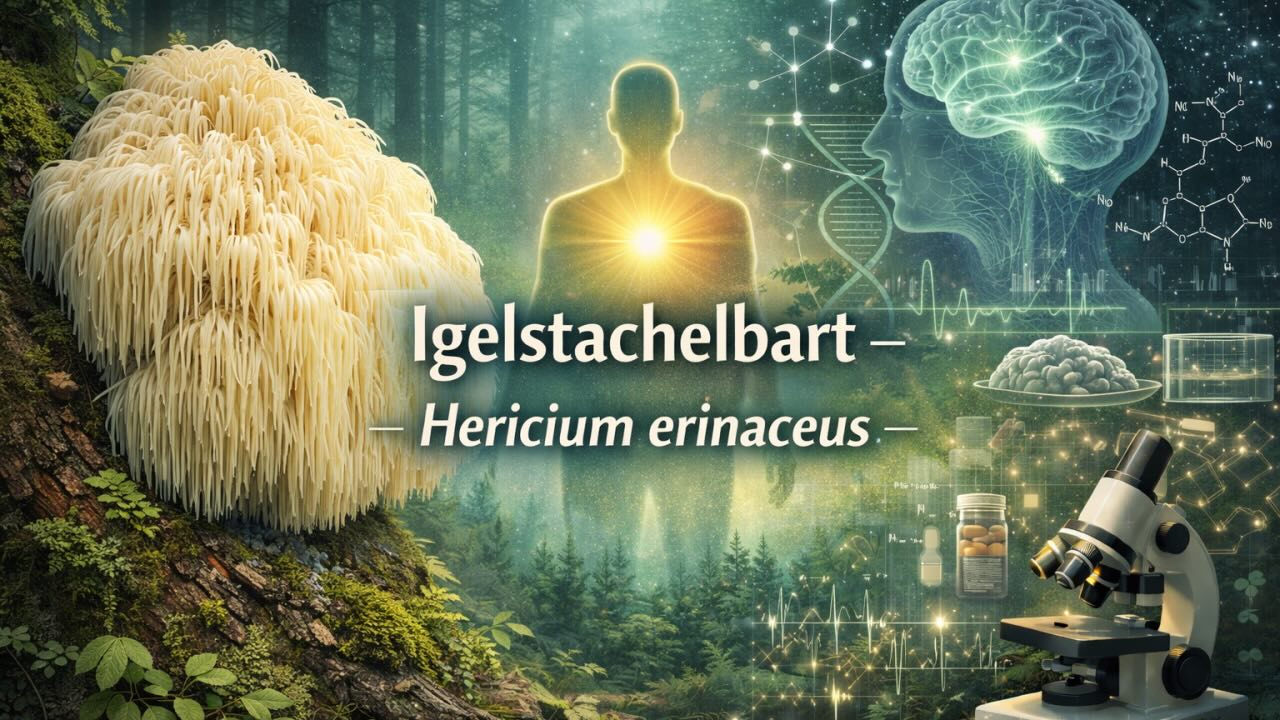
From a scientific perspective, this field is fascinating but heterogeneous: there are biochemically plausible mechanisms and numerous preclinical (cell/animal) studies—while the human evidence (randomized clinical trials, robust endpoints, adequate sample sizes) remains relatively sparse and, in some cases, mixed. The following 10 studies and reviews illustrate this tension very well.
Menon et al. (2025) is a systematic review published in Frontiers in Nutrition (“Benefits, side effects, and uses…”). It compiles human studies (including RCTs), pilot studies, and laboratory/computer models, and discusses areas of benefit (cognition, mood, gut microbiome, inflammation/oxidative stress, and, in some cases, cancer cell lines) as well as side effects (rare, mostly mild; however, a single report of a severe case is also discussed). Important: It also shows that the number of human studies is limited and the study designs vary widely. Source
Assessment: Very useful as an “evidence compass,” but as with many systematic reviews, the validity of the findings depends heavily on the quality of the included studies—and overall, the quality of studies on Hericium has not yet reached the level of established therapies.
Surendran et al. (2025) conducted a double-blind, randomized, placebo-controlled crossover study on the acute administration of a standardized fruit body extract to test its short-term effects on cognition and mood. Results: no clear improvement in global composite measures, but domain-specific signals (e.g., pegboard/manual dexterity) and partly contradictory effects on individual tasks. This is scientifically valuable because it tempers expectations of “immediate” cognitive effects and sharpens the focus on dosage, timing (peak concentration), and target population. Source
This study also emphasizes that fruiting bodies and mycelium differ in their bioactive profiles (hericenones vs. erinacines) and that regulatory and production factors also play a role. Source
Lai et al. (2013) serves as an excellent example of “2013 in vitro NGF/neurite outgrowth” research: The study demonstrates the neurotrophic effects of an aqueous extract (non-toxic in the tested cell lines), promotes neurite outgrowth in NG108-15 cells, including in combination with exogenous NGF—but does not show robust neuroprotection against oxidative stress under the selected conditions in this setup. Source
Assessment: Mechanistically plausible (neurotrophic “boost”), but in vitro remains in vitro: questions regarding dosage and bioavailability, as well as systemic complexity (immune system, blood-brain barrier, metabolism), remain unaddressed.
Friedman (2015) is a seminal, frequently cited study on the chemistry, nutrient profiles, and bioactive compounds of Hericium (polysaccharides/β-glucans, hericenones, erinacines, etc.). It serves as an important reference for making clear distinctions: Which classes of compounds exist, which are more commonly found in the fruiting body, which in the mycelium, and how does this align with the claimed effects (anti-inflammatory, antioxidant, immunomodulatory, neuroprotective, etc.)? Source
Assessment: Very strong biochemical basis, but this is a review—meaning there is no direct evidence of efficacy in humans.
“Frontiers Review (2025)”: Spangenberg et al. (2025) in *Frontiers in Pharmacology* is a systematic review of erinacins (cyathane diterpenoids from the mycelium) and their neurobiological effects in preclinical models. It addresses, among other things, antioxidant responses (including Nrf2), anti-inflammatory effects, neurogenesis/cell survival, and behavioral endpoints in animal models. Source
Assessment: Excellent for understanding the mechanism, but: preclinical studies cannot replace human RCTs. Furthermore, an “Erinacine-rich mycelium product” is not automatically the same as a “fruiting body product”—this is relevant for consumer communication and regulation.
Huang et al. (2021) in *Scientific Reports* show that mycelium extracts and individual bioactive compounds (including erinacine-associated components) can enhance the maturation of oligodendrocytes and increase markers such as MBP (myelin basic protein) in cell cultures and ex vivo systems; in addition, in vivo data from neonatal rats are reported. This is mechanistically interesting because it links Hericium not only to neurons (NGF/neurite outgrowth) but also to glia/myelin. Source
Assessment: Very promising for hypotheses regarding neurodevelopment and remyelination—but still a long way from clinical applications (e.g., MS or similar conditions). Furthermore: Animal models and developmental stages do not equate to adult human pathology.
Lew et al. (2020) in BMC Complementary Medicine and Therapies examined PC-12 cells under high-dose corticosterone stress (as a model for oxidative stress components discussed in the context of depression). A standardized aqueous extract improved cell viability, antioxidant enzyme activities, and mitochondrial parameters, and reduced ROS and apoptosis. Source
Conclusion: Solid evidence of mechanisms for antioxidant/mitochondrial protection—but this does not automatically translate into an effective antidepressant therapy in humans.
Chong et al. (2020) in *Scientific Reports* (“3-Acetylpyridine-Induced Cerebellar Ataxia in Rats”) report that Hericium extract can partially “rescue” motor deficits and link this to signaling pathways/markers such as ERK–CREB–PSD95 as well as other neuroplastic/BDNF-related parameters. Source
Assessment: Impressive in preclinical studies, but specific to the disease model. This cannot be directly applied to “healthy cognition” or “everyday stress.”
Khan et al. (2013) is an early, comprehensive review (“an edible mushroom with medicinal properties”) that covers antimicrobial, immunomodulatory, antioxidant, antitumor, and neuroprotective aspects, with a focus on β-glucans and other bioactive compounds. Source
Assessment: Historically significant as a consolidation—but naturally older, reflecting the state of the art at the time and lacking the level of differentiation seen today (e.g., the thicker erinacine/myelin strand was introduced later).
Chinese Medicine (2021): “Neurogenesis-dependent antidepressant-like activity…” The study uses a chronic stress model (CRS) in mice, tests Hericium extracts, and examines, among other things, BDNF–TrkB–CREB as well as neurogenesis markers and behavioral endpoints. This supports the hypothesis that Hericium can generate antidepressant-like signals not only through “antioxidant” mechanisms but also via neurotrophic/neurogenic pathways—at least in this animal model. Source
Assessment: Strong mechanistic basis, limited translational relevance (animal model, dose/administration, endpoints). Clinical implications require human studies.
When these 10 studies are considered together, three distinct clusters of mechanisms emerge:
(A) Neurotrophins & Plasticity (NGF/BDNF, Trk signaling, CREB/ERK/PSD95): In vitro, NGF-associated neurite outgrowth is promoted (e.g., Lai 2013) Source. In animal models, BDNF/CREB/PSD95 and plasticity-related markers appear repeatedly (ataxia model 2020; depression model 2021) Source Source. This is biologically plausible because neurotrophins play a role in learning, stress resilience, and neuronal repair.
(B) Antioxidant/anti-inflammatory (ROS, mitochondria, Nrf2, etc.): Cell models demonstrate protection against oxidative stress and mitochondrial stabilization (Lew 2020) Source. The Erinacine PRISMA review discusses antioxidant and pro-survival signals and systematically classifies them Source. This fits with a plausible “background noise” mechanism: less stress/inflammation → better neuronal function.
© Glia/Myelin (Oligodendrocyte Maturation): The 2021 Scientific Reports study opens up another avenue of inquiry: If myelin/glia maturation can be influenced, this would have conceptual relevance for development, learning, and possibly remyelination—but the clinical link is still very tenuous. Source
Here’s the key point: Human studies do exist, but they are not (yet) consistent or large enough to claim “therapeutic efficacy” in the medical sense.
In practical terms, this means that Hericium is a “promising” area of research, but the evidence base is still “emerging” rather than “clinically established.”
Several sources distinguish (implicitly or explicitly) between:
This distinction is important because consumer products vary widely (powder, extract, “10:1,” dual extract, mycelium on grain, etc.). Surendran et al. explicitly discuss these differences in the context of extract profiles and product selection in their study design. Source Friedman (2015) provides the chemical basis for this (which classes of compounds are more typical in which products). Source
Based on these 10 studies, one can reasonably conclude that:
Mycoverse Foundation
, Marktgass 11,
, 9490 Vaduz,
, Principality of Liechtenstein
Home | Vision | Projekte | Artikel | Vorstand/Beirat | Shop | Kontakt | Impressum/Datenschutz | Manage Cookie Settings