
Mushrooms have long since become more than just a culinary trend: they have emerged as a key issue in terms of the economy, health, and the environment. Whether as a superfood, a functional ingredient, or a raw material of the future—the mushroom market is booming.
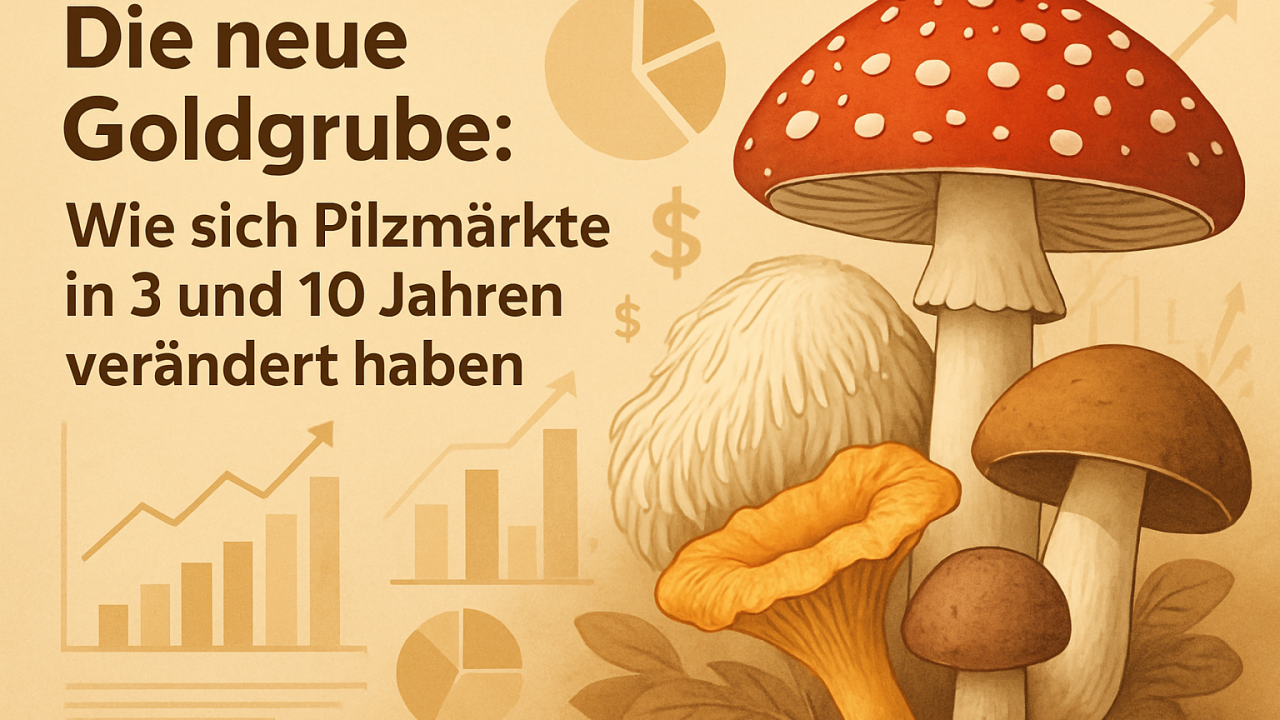
In this article, I analyze the most significant developments of the past 3 and 10 years—with strategic implications for businesses, research, policymakers, and consumers.
Over the past decade, the global mushroom market has evolved from a niche market into a multi-billion-dollar industry. Global sales of edible and functional mushrooms reached approximately $71.8 billion in 2024, with projections of $119.8 billion by 2033 (CAGR: 5.8%).
A key driver: the resurgence of functional mushrooms. Once a niche area of ethnobotany, they are now an integral part of the mainstream health industry. Asian markets led the way, but Europe and North America are now catching up rapidly.
Since 2021, the mushroom market has literally exploded. Mushroom-based functional foods, in particular, have seen tremendous growth. Sales of functional products—including coffee powder, elixirs, gummies, and tinctures—have risen by over 450% in the U.S. alone.
Brands like Four Sigmatic, Rainbo, and BeShroomed have made Lion’s Mane, Reishi, and other mushrooms accessible to the mass market. Even supermarkets and major retailers like Marks & Spencer now carry mushroom shots and dietary supplements with adaptogenic properties.
Functional mushrooms are at the heart of the new mushroom economy:
Year – Global Market Value of Medicinal Mushrooms
2023 – $31.7 billion
2030 – $65.8 billion (CAGR: 11.2%)
2033 – up to $76.4 billion (projected)
Top medicinal mushrooms:
The biotechnology industry is also rediscovering fungi—for example, in the development of:
The mushroom market is shifting: Asia remains the leading producer, but Europe and the U.S. are seeing the strongest growth in consumption.
Region – 2023–2030 Forecast – CAGR
Europe – $7.9 billion – $15.17 billion – 9.8%
United States – $3.9 billion – $8.57 billion – 11.9%
Driving forces: growing awareness of health in urban areas, rising demand for plant-based diets, and the desire for holistic prevention.
Mushrooms are now considered biotechnological all-rounders:
Visions of the future link mushrooms to the Sustainable Development Goals: for example, SDG 3 (Good Health and Well-being), SDG 12 (Responsible Consumption and Production), and SDG 15 (Life on Land).
Companies benefit from the transformation of the mushroom market in three ways:
Consumers are also rediscovering mushrooms—as:
Trust is growing: The desire for holistic regeneration aligns with the current trend toward personalized wellness.
The past three and ten years have marked the transition from a passion for mushrooms to the mushroom economy. The industry is only at the beginning of an ecological, medical, and technological revolution.
🌱 Those who invest today in mycotechnology, functional ingredients, or sustainable materials are shaping not only the market but also the health of people and the planet.
👉 The question is no longer whether, but how we use mushrooms—for food, medicine, the economy, and survival.
Dr. Lucas Pawlik
Mycoverse Foundation
, Marktgass 11,
, 9490 Vaduz,
, Principality of Liechtenstein
Home | Vision | Projekte | Artikel | Vorstand/Beirat | Shop | Kontakt | Impressum/Datenschutz | Manage Cookie Settings