
For years, there has been a heated debate in the world of functional mushrooms: fruiting bodies versus mycelium. This debate has become a mantra in the industry and serves as a simple way to communicate complex quality issues.
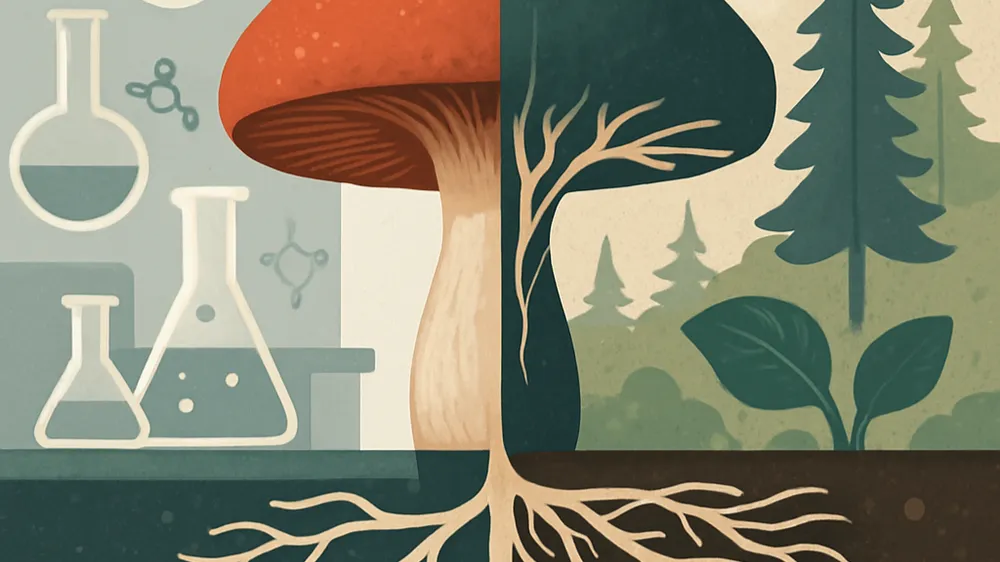
However, while this simplification certainly has its merits, it is based on shaky ground and represents a false dichotomy. As the industry matures and our understanding of functional mushrooms grows, it is time to rethink this outdated way of thinking.
To grasp the complexity of this debate, we must first understand the biology: mushrooms and mycelium are different structures produced by certain filamentous fungi. The mycelium is the actual body of the fungus, which exists throughout its entire life and performs all vital functions. The visible fungi—the “fruiting bodies”—are merely seasonal reproductive structures, comparable to the flowers of a plant.
This biological reality contradicts our fungus-centered view of the world. Since we see only the above-ground structures, we mistakenly regard them as the primary organism. This leads to misleading terms such as “fungal mycelium,” even though the mycelium is the actual organism and the fruiting body is merely a brief manifestation of the long-lived mycelium.
Criticism of mycelium in the functional mushroom industry is not unfounded. The market is dominated by low-quality mycelium-based products. A study published in *Nature* in 2017 tested 19 commercially available reishi supplements for key bioactive compounds. Only 26% of the samples contained all the expected bioactive compounds in adequate amounts. The rest showed high starch content—a clear sign of grain residues.
The real problem, however, lies not in the mycelium itself, but in the production method. These low-quality products are produced through “solid-state fermentation,” in which mycelium is cultivated on grain substrates such as oats or rice. The final product then consists mainly of undigested grain with only small amounts of mycelium.
As experts confirm, the conversion of grain into mycelium is never 100%. In some cases, the dry mycelium accounts for only about 10% of the total weight. This means that 90% of the product consists of fillers—a significant dilution of the valuable bioactive compounds.
What many people don’t know: Most clinical studies on medicinal mushrooms don’t use fruiting bodies at all. Of over 200 documented studies, only about 20% use fruiting body extracts. The vast majority use mycelium-based extracts or isolated compounds derived from mycelium.
These high-quality mycelium products are produced through “liquid fermentation”—a process in which mycelium is cultivated in nutrient-rich liquid media. This method enables the production of pure mycelium extracts without any grain residues. Well-known examples include:
The latter is particularly interesting, as erinacin A is found exclusively in the mycelium and is considered crucial for the cognitive benefits of lion’s mane.
The key question is not whether a product contains fruiting bodies or mycelium, but whether it provides the bioactive compounds in clinically relevant amounts. Consumers should ask: Which active ingredients are present, and in what quantities? Without this information, health claims are meaningless.
The industry needs clearer labeling standards. Products marketed as “Reishi mushroom” or “Lion’s Mane mushroom” often contain no mushroom tissue at all, but mainly undigested grains. A more honest label would be, for example, “Shiitake mycelium biomass (on oats)” or “Mycelium-cultured oats (Shiitake).”
The functional mushroom industry is at a turning point. Instead of getting bogged down in the simplistic fruiting body versus mycelium debate, we should focus on quality, transparency, and scientific validity. Both approaches—high-quality fruiting body extracts and pure mycelium products—have their merits and their place in the market.
The future does not lie in an “either-or” approach, but in educating consumers about the actual differences between product types. Only through transparency and scientific precision can the industry regain consumer trust and realize its full therapeutic potential.
The fruiting body versus mycelium debate is an oversimplification that does not do justice to the complexity of fungal biology. Instead of getting lost in this false dichotomy, the industry should focus on what really matters: providing effective, well-characterized products with verifiable bioactive compounds. Only then can the functional mushroom industry realize its potential as a serious player in the healthcare sector.
Dr. Lucas Pawlik
Mycoverse Foundation
, Marktgass 11,
, 9490 Vaduz,
, Principality of Liechtenstein
Home | Vision | Projekte | Artikel | Vorstand/Beirat | Shop | Kontakt | Impressum/Datenschutz | Manage Cookie Settings