
At a time when psychedelic research and consciousness studies are experiencing a renaissance, we need precise tools to understand the most complex human experiences. The Mystical Experience Questionnaire (MEQ) offers exactly that: a scientifically validated framework that maps the eight core dimensions of mystical states of consciousness.
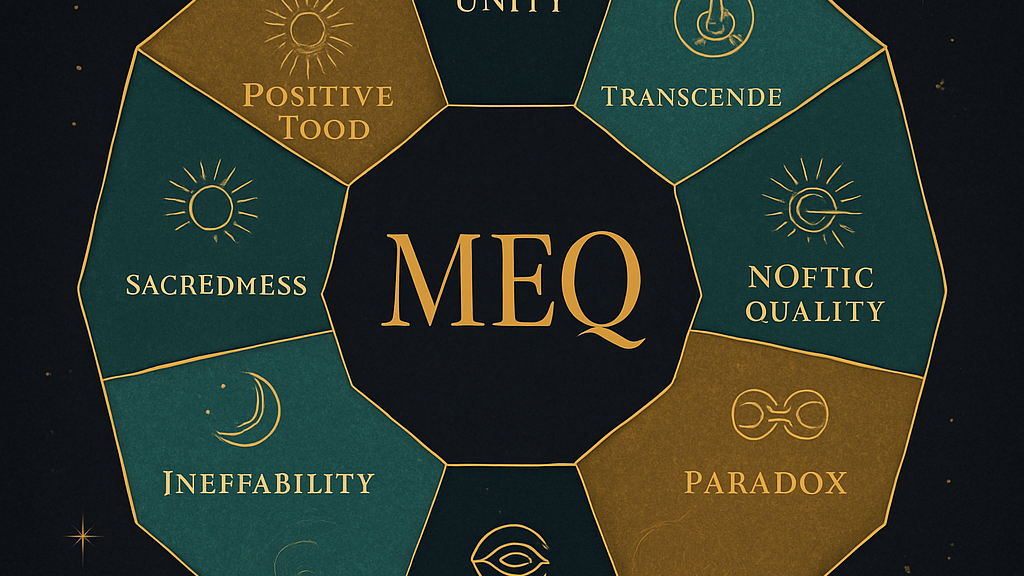
Developed through decades of research at Johns Hopkins University, the MEQ has established itself as the gold standard for measuring mystical experiences. For the first time, it enables the objective quantification of subjective states of consciousness—a methodological breakthrough that has revolutionized modern psychedelic research.
Mystical experiences are not esoteric fantasies, but neurobiologically measurable states of consciousness that can fundamentally transform people. From spontaneous spiritual awakenings to psychedelic-induced breakthroughs—these experiences follow recognizable patterns that the MEQ systematically captures.
The term “mystical” derives from the Greek “mystikos” (meaning “concerning the hidden”) and describes experiences that go beyond ordinary perception. As early as 1902, William James defined four main characteristics: ineffability, noetic quality, transience, and passivity. The MEQ expands upon and refines this classic definition using modern scientific methods.
The feeling of merging with all that exists. Participants report the dissolution of the subject-object divide—they are no longer observers of the world, but become one with it. This experience manifests itself in two forms: internal unity (the merging of various aspects of consciousness) and external unity (merging with the outside world).
From a neuroscientific perspective, this dimension correlates with reduced activity in the posterior cingulate cortex, a brain region associated with self-reference. Long-term studies show that people with high Unity scores exhibit lasting changes toward increased empathy, reduced egocentrism, and heightened environmental awareness.
Transcending the usual boundaries of space and time. People experience themselves beyond their physical existence, often accompanied by a sense of realizing universal truths. This dimension involves the experience of timelessness—minutes can feel like eons, or hours can pass in the blink of an eye.
From a neuroscientific perspective, transcendence manifests itself in altered activity in the default mode network, particularly in regions responsible for self-reflection and temporal orientation. Participants often describe feeling as though they are “outside of normal reality” and gaining a meta-perspective on their own existence.
Intense feelings of joy, peace, and love that go far beyond everyday experiences of happiness. This emotional intensity is often so overwhelming that it is described as “divine love” or “cosmic ecstasy.”
It is important to distinguish between superficial euphoria and this deep, all-encompassing positivity. The latter is accompanied by a sense of unconditional acceptance and universal love that extends even to difficult life experiences. This dimension activates the brain’s reward system in a unique way and can have lasting antidepressant effects.
The fundamental inability to put the experience into words. Paradoxically, it is precisely this linguistic limitation that is a hallmark of authentic mystical states—they transcend our conceptual thinking.
Participants often use metaphors, poetry, or religious language to communicate the inexpressible. This dimension points to the limits of language itself: while ordinary experiences can be put into words, mystical states transcend our symbolic systems. Neurologically, this correlates with reduced activity in language-processing regions of the brain during the experience.
The perception of a sacred, divine quality in experience. Even non-religious people speak of a sense of the sacred that profoundly shapes their worldview. This dimension goes beyond traditional religiosity and describes a fundamental awe of existence itself.
It is interesting to note that sacredness transcends cultural boundaries, regardless of a person’s religious background. Atheists suddenly describe “divine” experiences, while religious people often report that their mystical experiences both confirmed and transcended their previous beliefs. This dimension activates regions of the brain associated with spiritual experience and moral sensibility.
The unshakable feeling of having discovered absolute truths, combined with a certainty that transcends rational thought. These “insights” often retain their subjective validity, even if they cannot be explained rationally.
Noetic knowledge differs from ordinary knowledge in its immediate, intuitive nature. Participants report having “direct knowledge” without logical deduction—they “simply know” certain truths about the nature of reality, consciousness, or their own existence. These insights are often of existential significance and have a long-term impact on life decisions and worldview.
The simultaneous experience of seemingly contradictory states—emptiness and fullness, individuality and unity, death and life. These paradoxes are experienced not as logical problems, but as deeper truths.
The mystical paradox transcends Aristotelian logic and opens up a dimension of experience beyond binary thinking. Participants can simultaneously be “everything” and “nothing,” feeling completely dissolved yet more intensely present than ever before. This dimension may reflect fundamental properties of consciousness that are obscured by conceptual thinking in ordinary states.
The fleeting nature of experience, often accompanied by a desire to capture it. Paradoxically, it is precisely this transience that enhances its transformative effect. The conscious experience of transience teaches acceptance and, at the same time, makes the experience more precious.
Participants often describe a sense of “returning” to ordinary reality, accompanied by sadness over the loss and, at the same time, gratitude for the experience. This dimension connects mystical experiences with Buddhist concepts of the impermanence of all phenomena and can lead to deeper insights into letting go and acceptance.
The MEQ enables researchers to objectively quantify subjective states of consciousness. In clinical studies on psilocybin, LSD, and other psychedelics, MEQ scores show strong correlations with therapeutic success in treating depression, anxiety disorders, and substance use disorders.
Recent research findings show:
The MEQ was validated by several independent research groups involving a total of over 3,000 participants. Its internal consistency (Cronbach’s alpha > 0.9) and test-retest reliability are excellent, making it suitable for clinical and research applications.
The MEQ is typically administered 6–8 hours after a psychedelic session to capture the experience while it is still fresh in the participant’s memory. The 30 items are rated on a 6-point Likert scale, ranging from “0 = not at all” to “5 = extremely.”
Sample items:
The assessment is based on both dimensional measures (eight subscales) and a total score that reflects the intensity of the mystical experience. A score of ≥60% of the maximum is considered a “full mystical experience.”
For therapists, researchers, and anyone who works with states of consciousness, the MEQ offers:
Diagnostic Clarity: Distinguishing Between Mystical and Other Extraordinary States
Therapeutic Approach: Targeted Integration of Experiential Elements into Aftercare
Scientific Precision: Comparable Data for Interdisciplinary Research
As we enter a new era of psychedelic medicine, tools like the MEQ are becoming indispensable. They enable us to scientifically capture the most profound human experiences without diminishing their essence.
The eight dimensions of mystical experience are more than just academic categories—they serve as guides to a deeper understanding of human consciousness and its transformative potential. Recent developments include the integration of neuroimaging data, the development of real-time MEQ assessments, and adaptation for various cultural contexts.
Despite its scientific rigor, the MEQ has limitations. Reducing complex states of consciousness to quantitative scales can overlook important qualitative nuances. Cultural and linguistic factors influence the interpretation of the items. Furthermore, the MEQ primarily captures positive mystical experiences and pays less attention to “dark” or challenging spiritual states.
Future research is focused on developing expanded versions of the MEQ that also capture complex mystical experiences, diverse cultural perspectives, and long-term integration. Machine learning helps identify patterns in MEQ data that are relevant to personalized therapeutic approaches.
How can we use these insights to promote both individual healing and social transformation? The answer lies in the careful, respectful exploration of what makes us most deeply human: our ability to transcend the limits of ordinary consciousness and, in doing so, find healing, wisdom, and connection.
Dr. Lucas Pawlik
Research into mystical experiences is still in its infancy. Every validated dimension brings us closer to understanding the most complex aspects of human consciousness and applying them therapeutically.
Mycoverse Foundation
, Marktgass 11,
, 9490 Vaduz,
, Principality of Liechtenstein
Home | Vision | Projekte | Artikel | Vorstand/Beirat | Shop | Kontakt | Impressum/Datenschutz | Manage Cookie Settings