
Beneath our feet lies a vast, invisible network that could hold the key to humanity’s most pressing challenges. Welcome to the world of fungi.
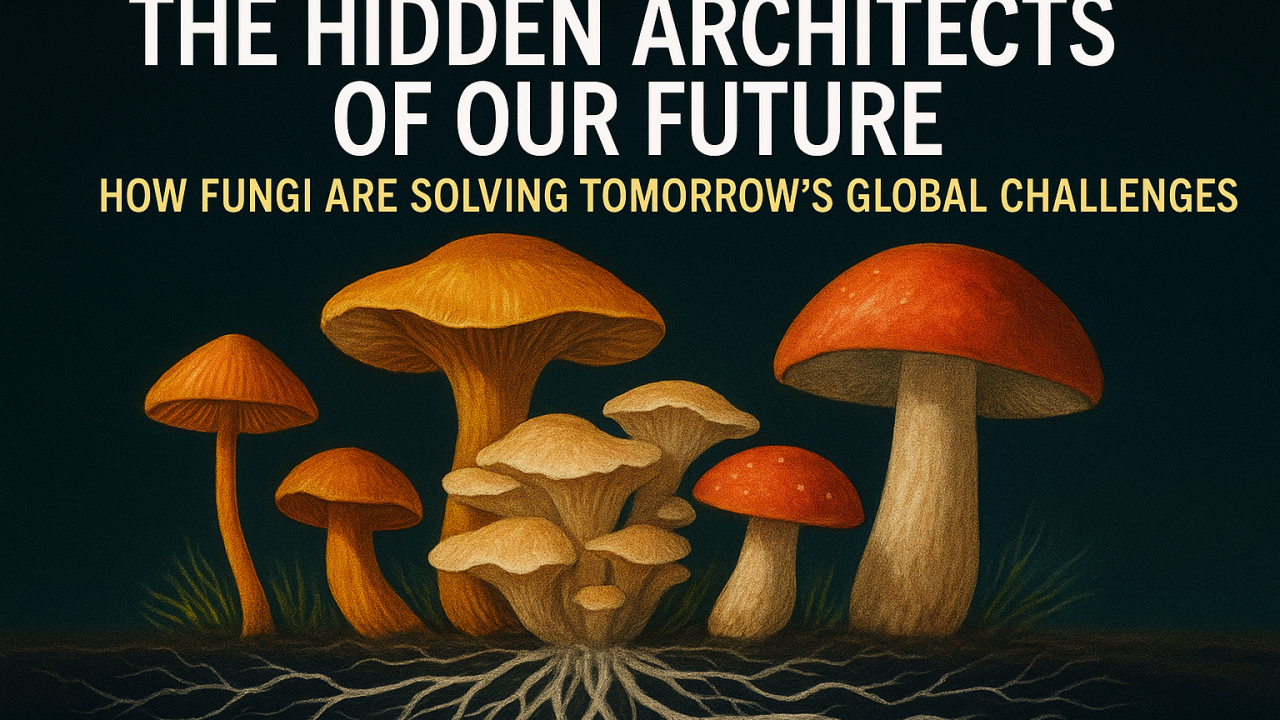
While we discuss digital transformation above ground, nature has been operating the world’s most sophisticated network for millions of years. Fungal mycelium —those thread-like structures that form the vast underground network of fungi—is one of the most critical yet most overlooked systems on Earth.
Keep in mind: Only 10% of fungi produce the fruiting bodies that we see above ground. The rest of this ancient kingdom works invisibly, creating the very foundation of life on Earth. Without fungi, there is no soil. Without soil, there is no life as we know it.
Here’s a fact that should change the way we think about climate solutions: Most of the CO₂ in our biosphere isn’t stored by the plants themselves, but is absorbed by the mycelium in the soil. While we focus on planting trees (which is important), we overlook the underground heroes that actually store the carbon.
Plants transfer at least 70% of their photosynthetically produced carbon directly to fungi via their roots, exchanging it for essential nutrients. This ancient partnership has been quietly managing the Earth’s carbon cycle for hundreds of millions of years.
The figures are staggering. The global bio-based economy—which relies heavily on fungal applications—is estimated to be worth $355 billion, with a total economic impact of $505 billion and 4.63 million jobs.
Nevertheless, we have discovered and studied only about 8% of the estimated 2.2–3.8 million species of fungi on Earth. Some estimates put the total at up to 5.1 million species. Imagine the untapped potential in the remaining 92%.
Mushrooms don't just preserve—they actively restore. Through mycofiltration and mycorestoration, we can:
The interaction between humans, bees, trees, and fungi (MBBP) provides a blueprint for myco-forestry and myco-medicine that could make our forests resilient to ecological collapse.
Mushrooms directly contribute to the simultaneous achievement of several UN Sustainable Development Goals:
We are at a critical turning point. The enormous financial value of mushrooms—estimated in initial studies at $54.57 billion worldwide—underscores why we must act now to:
The fungal kingdom lives within us and all around us—in the soil beneath our feet, in the air we breathe, and even in our own microbiomes. These ancient organisms have been the architects of life on Earth for hundreds of millions of years.
Now that we are facing unprecedented global challenges, perhaps it is time for us to learn from the masters of sustainability themselves.
The question is not whether mushrooms can help us solve the challenges we face in the future—but whether we are wise enough to listen to what they have been teaching us all along.
Mycoverse Foundation
, Marktgass 11,
, 9490 Vaduz,
, Principality of Liechtenstein
Home | Vision | Projekte | Artikel | Vorstand/Beirat | Shop | Kontakt | Impressum/Datenschutz | Manage Cookie Settings