
Near-death experiences, psilocybin, second-order cybernetics, and the surprising connections between consciousness, conversation, and artificial intelligence. By Lucas Pawlik | Mycoverse Foundation A Conversation That Became Something Else When Zen Benefiel invited me to his podcast, What Happens When We Die? Finding Answers in the Unknown, I was looking forward to our conversation, but I also […]
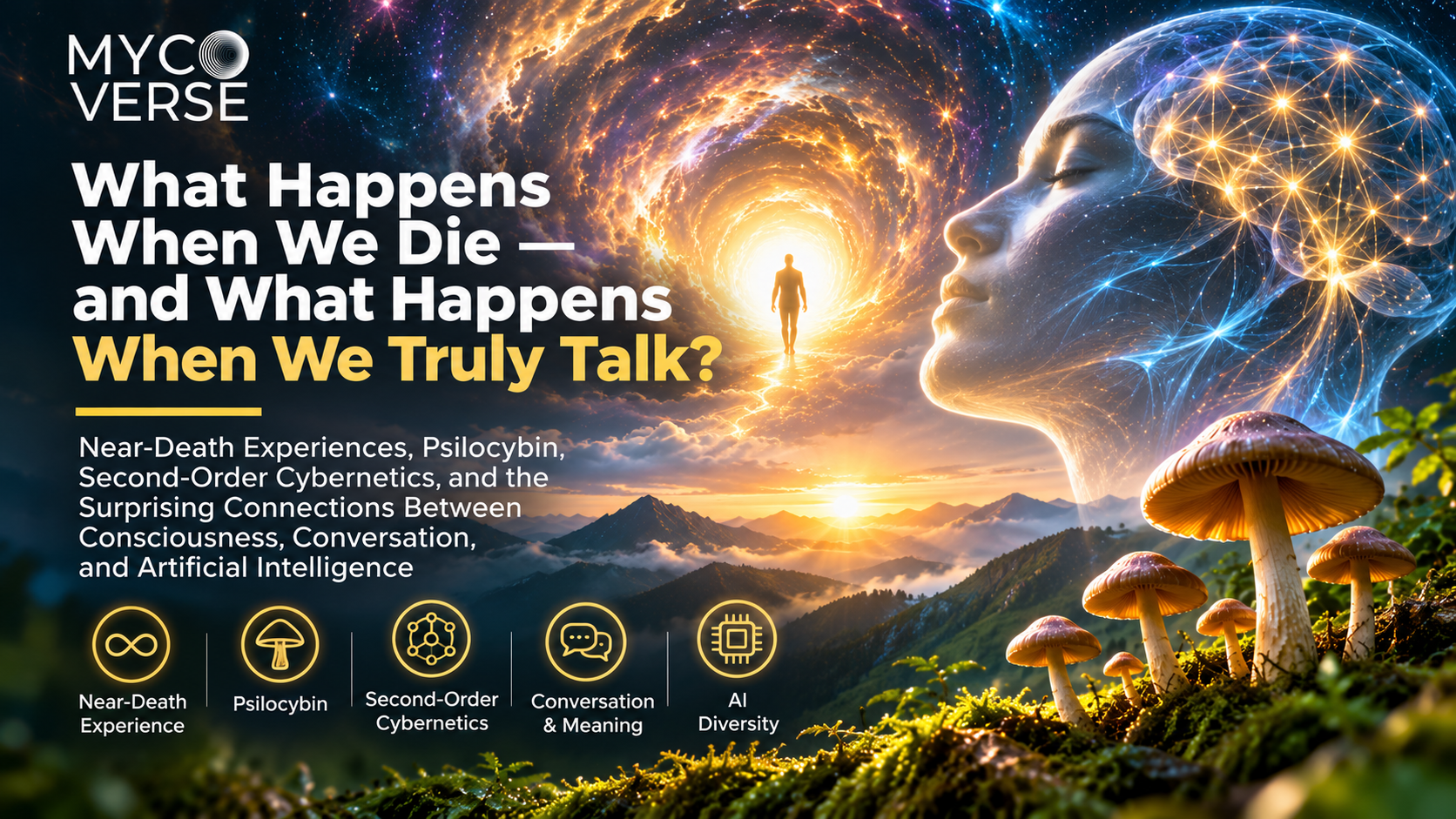
Near-death experiences, psilocybin, second-order cybernetics, and the surprising connections between consciousness, conversation, and artificial intelligence.
By Lucas Pawlik | Mycoverse Foundation
When Zen Benefiel invited me to his podcast, What Happens When We Die? Finding Answers in the Unknown, I was looking forward to our conversation, but I also had a concern.
English is my second language. I wondered whether I would be able to express ideas that are already difficult to put into words in my native German: my near-death experience, the nature of consciousness, the philosophy of Heinz von Foerster and Humberto Maturana, and the relationship between mystical experiences and our understanding of reality.
Something unexpected happened.
As we talked, I gradually forgot that we were recording a podcast. My concern about finding the right English words disappeared. Zen and I became absorbed in the questions we were exploring together.
One thought led to another. Connections emerged that neither of us had planned. At some point, the conversation seemed to develop a life of its own.
Only afterwards did I fully recognize how closely this experience reflected one of the central ideas of second-order cybernetics: We create our worlds through the ways we observe, communicate, and interact with one another.
And sometimes a conversation changes the very observers who are participating in it.
This is the story of that conversation, the experiences and ideas behind it, and why I believe these questions are becoming increasingly important in a world shaped by artificial intelligence.
🎥 Watch the full conversation with Zen Benefiel:
One of the first subjects we explored was the meaning of apocalypse.
Today, the word usually evokes images of catastrophe, destruction, and the end of the world.
Yet the original Greek word, apokálypsis, means uncovering or unveiling.
I find this original meaning much more interesting.
What if an apocalypse is something that happens whenever the familiar reality through which we understand our lives is suddenly revealed to be only one possible way of seeing?
A belief we have held for decades may collapse. An unexpected encounter may transform our understanding of another person. A profound mystical experience may dissolve the boundaries of what we previously considered possible.
Something hidden becomes visible.
In that sense, an apocalypse does not necessarily destroy our world. It may reveal how we have been creating that world all along.
And once we recognize the assumptions and distinctions through which our reality is organized, we may discover that we can make different distinctions.
This understanding connects directly to my own near-death experience.
In 2016, I had an accident that led to a profound near-death experience.
On the Greyson Near-Death Experience Scale, a scientific instrument developed to assess the characteristic features and intensity of such experiences, my experience scored 30 out of 32 possible points.
But a numerical score can say very little about what such an experience actually feels like.
My experience unfolded in two phases.
The first began even before the impact, triggered by the overwhelming realization that I might die.
The second followed the accident itself.
At its center was an encounter with a divine light.
This light was extraordinary, but also deeply familiar.
It reminded me of something I had almost forgotten.
As a child, I had dreamed of dissolving into such a light. Later in life, those memories had become buried beneath the demands and painful experiences of growing up.
School had been particularly difficult for me. I sometimes felt as though I must have been cursed, or perhaps foolish, to have entered human existence at all.
My near-death experience brought those childhood memories back with extraordinary clarity.
And the light was familiar in another way.
I had encountered something profoundly similar during earlier experiences with psilocybin.
This connection between psychedelic experiences and near-death experiences would later become one of the central themes of my research and writing.
One of the most extraordinary moments of my near-death experience involved a vision of reality as an immense network of communicating crystals.
I cannot say whether what I perceived was the biosphere or the entire universe.
Every element was connected with every other element.
And I was part of that network.
Yet simultaneously, I experienced myself as the whole.
There was no ordinary separation between an observer looking at the world and the world being observed.
Much later, I found a strikingly similar image in the ancient metaphor of Indra’s Net.
In this image, an infinite network contains jewels, each reflecting every other jewel. Every part contains reflections of the whole.
For me, this was more than an interesting philosophical comparison. It was a way of communicating something that ordinary language struggles to express.
Heinz von Foerster, who had supported my work in second-order cybernetics and had died in 2002, also appeared within this extraordinary experience.
His presence connected the experience to questions I had been exploring intellectually for many years.
What is an observer?
What is reality?
And what happens when the distinction between observer and observed disappears?
Heinz von Foerster was one of the central figures in the development of second-order cybernetics.
Traditional cybernetics studies systems, their behavior, and the processes through which they regulate themselves.
Second-order cybernetics takes another step.
It asks what happens when we include the observer within the system being observed.
This has profound consequences.
Every observation depends upon the distinctions made by an observer. What we experience as reality is inseparable from the biological and cognitive processes through which we perceive and describe it.
Von Foerster famously challenged the assumption that an observer could describe the world from a completely independent position.
We are always participants in the worlds we describe.
My near-death experience made this philosophical insight intensely personal.
During the experience, I did not perceive myself as a separate individual looking at a universe outside me.
I experienced myself as an inseparable part of an immense, interconnected whole.
The experience profoundly changed how I subsequently understood myself, other people, and the world.
Of course, the subjective character of such an experience does not establish a scientific theory about the ultimate nature of reality.
But the experience changed the observer who would thereafter ask those scientific and philosophical questions.
And this is precisely where second-order cybernetics becomes relevant.
An experience can transform not only what we believe about the world, but also the way we observe and bring forth a world in the first place.
My book, Mystical Medicine: The Healing Reality of Psilocybin, Near-Death, and Dying, grew from my attempt to understand this transformation and the similarities between near-death experiences, psychedelic experiences, and experiences encountered at the end of life.
Our conversation naturally led to Humberto Maturana, whose work has been deeply important to my understanding of human beings.
Together with Francisco Varela, Maturana developed a biological approach to cognition that challenged the idea that living organisms simply receive information from a pre-existing external world.
Living systems respond to their environments according to their own structures and histories.
For human beings, these interactions become particularly complex through language.
Maturana used the term languaging to describe the ongoing coordination of human behavior through language.
He understood conversations as involving both languaging and emotioning, continuously intertwined.
This means that conversations involve far more than exchanging information.
We coordinate our actions, feelings, interpretations, and expectations with one another.
Through these ongoing interactions, our relationships and shared realities emerge.
I find this idea especially important today.
We often think of communication as the transmission of a message from one mind to another.
But a genuine conversation can produce something that neither participant possessed beforehand.
A new thought appears.
A familiar assumption is challenged.
A different possibility becomes visible.
In this sense, conversation is one of the fundamental processes through which human worlds are created and transformed.
And this brings us back to what happened during the podcast.
Zen and I began with our own experiences, questions, and ideas.
But the conversation gradually moved beyond what either of us had prepared.
We were discovering the connections as we spoke.
There is another unexpected connection here.
In psychedelic research, scientists have investigated the relationship between a person’s psychological disposition and the experiences that emerge under substances such as psilocybin.
Studies suggest that openness and the ability to surrender to an unfolding experience are associated with more positive and mystical-type experiences.
Resistance, fear, and attempts to maintain rigid control can contribute to challenging experiences.
This does not mean that difficult experiences are always caused by resistance. Psychedelic responses are complex and depend upon many psychological, biological, and environmental factors.
Nevertheless, the relationship between surrender and transformation is fascinating.
During a profound psychedelic experience, a person’s ordinary sense of self may temporarily dissolve.
Familiar boundaries can disappear.
The individual may experience a profound sense of unity, interconnectedness, or participation in a greater reality.
Something similar can occur during a near-death experience, although the circumstances are radically different.
And I believe there is an important parallel in conversation.
When we enter a conversation determined to defend our existing beliefs, we limit what can happen.
When we allow a conversation to unfold, remain curious, and genuinely consider what another person is saying, new possibilities can emerge.
The observer becomes open to transformation.
This does not mean abandoning critical thinking or giving up personal responsibility.
It means allowing our existing understanding to change through the encounter.
Surrender, in this sense, can become the beginning of a different kind of agency.
We become capable of acting differently because we have become capable of observing differently.
This brings us to a subject that might initially seem far removed from mystical experiences: artificial intelligence.
Yet during the podcast, the connection became increasingly clear.
If human realities emerge through conversations, what happens when more and more of those conversations are influenced by a small number of artificial intelligence systems?
Today, millions of people use AI to explore questions, formulate arguments, make decisions, write texts, and interpret information.
These systems are becoming participants in the processes through which we construct meaning.
This creates extraordinary opportunities.
But it also raises a serious concern.
What happens when a large proportion of human communication is mediated through systems developed by only a few companies, sharing similar architectures, training sources, and assumptions?
I have argued for what I call AI biodiversity.
The analogy comes from ecology.
In a healthy ecosystem, diversity contributes to resilience. Different organisms respond differently to environmental changes. Their interactions create possibilities that no single organism could produce alone.
A monoculture, by contrast, can become highly vulnerable because its components share similar weaknesses.
Research on algorithmic monoculture has identified related problems.
When many institutions use the same algorithmic systems, their decisions may become increasingly correlated. Errors and biases can be reproduced across different contexts.
Researchers have described this process as outcome homogenization.
The concern extends beyond individual decisions.
If a small number of AI systems increasingly shape how people formulate questions, evaluate possibilities, and describe reality, they may also influence the diversity of human perspectives.
This is why I believe we need an ecology of artificial intelligence systems.
Different architectures, different training traditions, different cultural perspectives, and different communities of developers can contribute to a richer landscape of possibilities.
The aim is not diversity for its own sake.
It is to preserve and expand the range of ways in which human beings can think, communicate, and act.
And this brings us to one of Heinz von Foerster’s most important contributions.
Von Foerster formulated an ethical imperative that has remained central to my thinking:
Act always so as to increase the number of choices.
For me, this simple principle connects all the themes we explored during the podcast.
A near-death experience may reveal possibilities of understanding that were previously unimaginable.
A psychedelic experience may loosen deeply established patterns of perception.
A genuine conversation may create meanings that neither participant could have produced alone.
And a diverse ecology of artificial intelligence systems can preserve alternative perspectives rather than allowing one dominant framework to shape everyone’s thinking.
In each case, the fundamental question is the same.
Does this experience, interaction, or technology expand our possibilities?
Or does it reduce them?
I believe this question should become increasingly central to the ethical development of artificial intelligence.
The quality of an AI system cannot be assessed solely through its accuracy, efficiency, or ability to produce convincing answers.
We must also ask what happens to human agency when people interact with it.
Does it encourage exploration?
Does it make different perspectives accessible?
Does it support independent judgment?
Does it help people develop their own understanding?
These questions matter because artificial intelligence is becoming part of the conversational environment in which human realities emerge.
There was another question running through our conversation.
What happens after a transformative experience?
A near-death experience may profoundly change a person’s relationship with mortality.
A psilocybin experience may produce a lasting sense of connectedness with other people and with nature.
People who accompany the dying may reconsider their assumptions about what makes life meaningful.
But how do these personal transformations become relevant beyond the individual?
Research into near-death and psychedelic experiences has repeatedly documented changes in attitudes toward death, personal values, and perceptions of meaning.
These changes can be deeply significant.
Yet an individual transformation does not automatically become collective action.
That requires another process.
It requires communication, relationships, shared purposes, and institutions through which new values can become practical commitments.
In Mystical Medicine, I describe a convergence of these transformative possibilities through what I call the M.E.G.A. effect: Make Earth Great Again.
The underlying idea is that a transformed understanding of life may lead to a greater willingness to care for the living world.
A reduced fear of death can change how we value life.
A greater sense of interconnectedness can change how we understand our responsibilities toward other people, other species, and the ecosystems of which we are part.
These possibilities are also central to my involvement with the Mycoverse Foundation.
The Mycoverse Foundation, based in Vaduz, Liechtenstein, brings together projects addressing fungi, health, food, soil, water, and biodiversity.
As head of its Ethics Council, I am particularly interested in the connections between scientific knowledge, values, and the ways people understand their relationship with the living world.
Fungi provide a fascinating starting point.
They are among the fundamental organisms maintaining ecological processes on Earth.
They participate in nutrient cycling, decompose organic matter, form symbiotic relationships with plants, and influence the functioning of entire ecosystems.
Studying fungi means studying relationships.
And relationships are also at the center of second-order cybernetics.
One of the Foundation’s initiatives, Project 6: Mystical Experiences Across Life Contexts, examines the significance of mystical experiences in rehabilitation, the search for meaning, and the end of life.
This work connects naturally with the themes of my book and my personal experience.
We are interested in how transformative experiences can be understood, accompanied, and integrated into everyday life.
And how the changes individuals undergo might contribute to new forms of cooperation and care.
This is where the philosophical question of the observer becomes an ethical and practical question.
How do transformed observers participate in transforming the world they share?
Looking back, I find one aspect of the conversation particularly revealing.
The connections between our subjects were not planned.
We did not prepare a sequence leading from apocalypse to near-death experiences, from there to constructivism, dialogue, artificial intelligence, and finally the Mycoverse Foundation.
The structure emerged through the conversation itself.
Each question changed the context in which the next answer became possible.
Each answer opened a new question.
At one point, Zen and I became so immersed in the exploration that the podcast format faded into the background.
For me, this was an example of Maturana’s understanding of conversation.
We were engaged in an ongoing coordination of meanings, emotions, and actions.
The conversation became part of the environment through which it continued to develop.
It also reminded me of Marshall McLuhan’s famous proposition that the medium is the message.
A long-form video conversation makes something possible that short social media posts often cannot accommodate.
There is time to hesitate.
Time to search for a word.
Time to follow an unexpected connection.
Time to discover that the other person has understood something differently.
And time to let that difference change the direction of the conversation.
My initial concern about speaking English became part of this process.
Because I had to search carefully for certain words, I sometimes expressed myself more slowly and deliberately.
A listener later told me that this care could be felt in the recording.
Perhaps what initially appeared to be a limitation became part of what made the conversation meaningful.
I have increasingly come to regard long-form podcasts as places where something resembling higher education can still flourish: shared inquiry, intellectual curiosity, and the willingness to pursue a question without already knowing the answer.
This brings me back to where the conversation began.
Apocalypse as unveiling.
A near-death experience can unveil assumptions about ourselves and reality that we did not even know we possessed.
A psychedelic experience can temporarily dissolve familiar structures of perception.
A philosophical insight can reveal that what appeared to be an objective description of the world also depended upon the observer making that description.
A genuine conversation can make visible possibilities that none of its participants had anticipated.
And the development of artificial intelligence now challenges us to consider how we can preserve and expand those possibilities in an increasingly technologically mediated world.
Perhaps living apocalyptically means learning to recognize these moments of unveiling in everyday life.
To remain curious about what our own assumptions conceal.
To encounter other people as possible partners in the creation of meaning.
To recognize that our understanding of reality is always part of an ongoing process.
And to act in ways that increase the possibilities available to ourselves and others.
In this sense, von Foerster’s ethical imperative is more than an abstract philosophical principle.
It becomes a practical orientation toward life.
Act always so as to increase the number of choices.
The remarkable thing about my conversation with Zen Benefiel is that we were exploring this principle while, through the conversation itself, creating possibilities neither of us had anticipated.
We were discussing how human worlds emerge through communication.
And at the same time, we were participating in precisely that process.
Perhaps that is what makes conversation such a powerful human activity.
Every genuine conversation contains the possibility that we will emerge from it seeing the world differently.
And sometimes, that is where transformation begins.
🎥 What Happens When We Die? Finding Answers in the Unknown — Zen Benefiel with Lucas Pawlik
In this conversation, we explore my near-death experience, mystical experiences with psilocybin, second-order cybernetics, the philosophy of Heinz von Foerster and Humberto Maturana, the importance of dialogue, AI biodiversity, and the work of the Mycoverse Foundation.
I invite you to watch the conversation and bring your own observations into the discussion.
What experiences or conversations have fundamentally changed the way you understand reality?
And how can we create more opportunities for such transformations in a world increasingly shaped by algorithms?
Aday, J. S., et al. (2021). Predicting reactions to psychedelic drugs: A systematic review of states and traits related to acute drug effects. ACS Pharmacology & Translational Science, 4(2), 424–435.
Bommasani, R., et al. (2022). Picking on the same person: Does algorithmic monoculture lead to outcome homogenization? Advances in Neural Information Processing Systems, 35.
Greyson, B. (1983). The near-death experience scale: Construction, reliability, and validity. Journal of Nervous and Mental Disease, 171(6), 369–375.
Haijen, E. C. H. M., et al. (2018). Predicting responses to psychedelics: A prospective study. Frontiers in Pharmacology, 9, 897.
Kleinberg, J., & Raghavan, M. (2021). Algorithmic monoculture and social welfare. Proceedings of the National Academy of Sciences, 118(22), e2018340118.
Maturana, H. R. (1988). Reality: The search for objectivity or the quest for a compelling argument. Irish Journal of Psychology, 9(1), 25–82.
Maturana, H. R., & Varela, F. J. (1987). The Tree of Knowledge: The Biological Roots of Human Understanding. Shambhala.
McLuhan, M. (1964). Understanding Media: The Extensions of Man. McGraw-Hill.
Pawlik, L. (2026). Mystical Medicine: The Healing Reality of Psilocybin, Near-Death, and Dying. Presshaus Sonnberg / Mycoverse Foundation.
Von Foerster, H. (2003). Understanding Understanding: Essays on Cybernetics and Cognition. Springer.
Watts, A. (1966). The Book: On the Taboo Against Knowing Who You Are. Pantheon.
Wittgenstein, L. (1922). Tractatus Logico-Philosophicus.
Lucas Pawlik is a philosopher and cybernetician and leads the Ethics Council of the Mycoverse Foundation. His work explores consciousness, near-death experiences, psychedelics, second-order cybernetics, and the relationship between personal and collective transformation.
Fundación Mycoverse
Marktgass 11
9490 Vaduz
Principado de Liechtenstein
Home | Vision | Projekte | Artikel | Vorstand/Beirat | Shop | Kontakt | Impressum/Datenschutz | Manage Cookie Settings