
A Concept Paper on Ecology, Democracy, and the Sustainable Development Goals 1. Introduction: Vision and Background The Gandhian Garden Concept draws its inspiration from the timeless wisdom of Mahatma Gandhi and Aristotle—two figures separated by millennia yet united in their recognition that the garden is not merely a plot of land but the foundation of […]
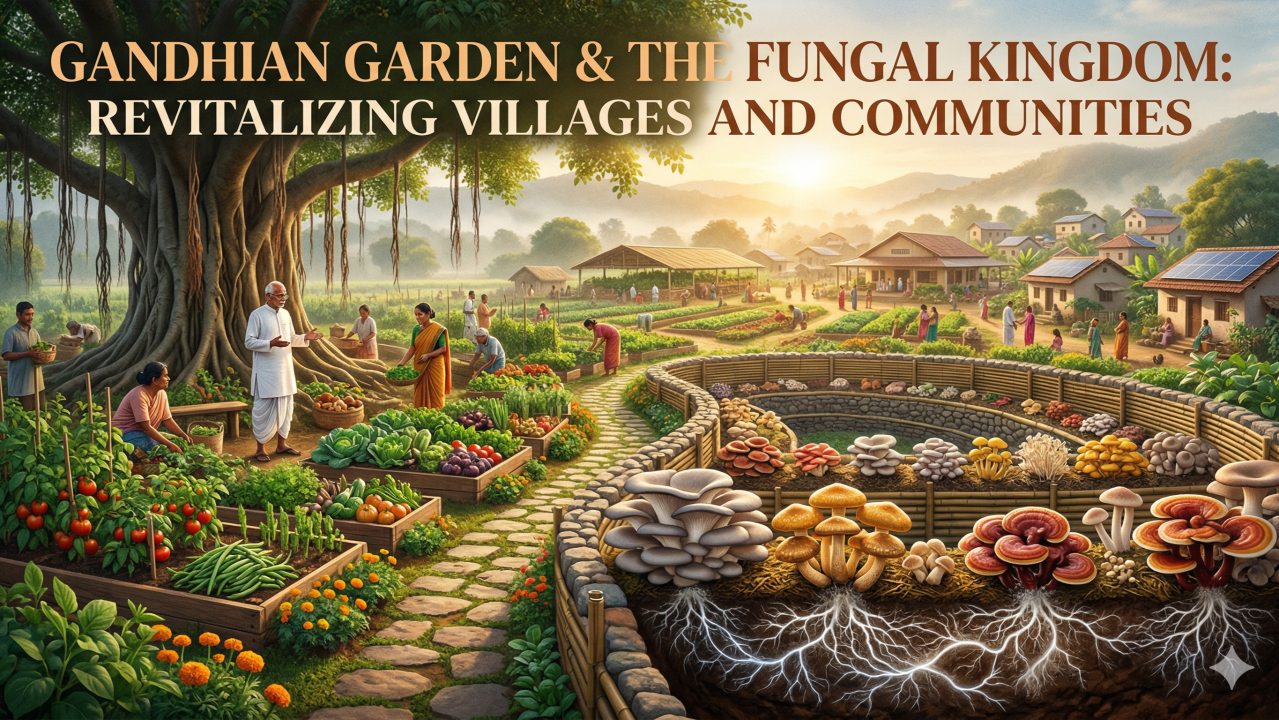
The Gandhian Garden Concept draws its inspiration from the timeless wisdom of Mahatma Gandhi and Aristotle—two figures separated by millennia yet united in their recognition that the garden is not merely a plot of land but the foundation of human civilization. For Aristotle, the garden was the site of teaching, contemplation, and the cultivation of ethical citizens. For Gandhi, his garden was the basis of his food supply, his medical care, his understanding of economics, and the ethical ground from which his vision of democracy grew.
In an era defined by ecological collapse, democratic backsliding, and widespread mental and physical health crises, returning to an autonomous, sustainable garden culture offers a pathway to healing both our environment and our communities. The garden, understood in this tradition, is not a retreat from the world but a model for it—a living demonstration of how humans can meet their fundamental needs while regenerating the ecosystems upon which all life depends.
This concept paper outlines a framework for revitalizing villages and communities by integrating Gandhian garden principles with the transformative potential of the fungal kingdom. It presents a holistic strategy grounded in ecological restoration, democratic participation, and the United Nations Sustainable Development Goals (SDGs).
Gandhi’s agricultural vision was never merely about food production. It was a comprehensive theory of democratic citizenship grounded in an ecological relationship. He understood that genuine political freedom is impossible without personal autonomy, and personal autonomy begins not with rights or representation but with the soil beneath one’s feet.
The Three Pillars of Independence
Nourishment Independence means the capacity to produce food from local soil without reliance on global supply chains, corporate seed patents, or synthetic inputs. It is the most fundamental form of freedom—the one upon which all others depend. A citizen who cannot feed themselves is structurally vulnerable to exploitation, regardless of what their ballot paper says.
Medical Independence means the capacity to prevent and treat illness using locally available plants and fungi, grounded in both traditional knowledge and contemporary science. A citizen whose health depends entirely on pharmaceutical corporations and centralized medical institutions is not truly free. The COVID-19 pandemic revealed with brutal clarity how dependency on distant supply chains and corporate-controlled medicine leaves entire populations vulnerable.
Economic Independence emerges when basic needs are met through one’s own labor and ecological relationships, reducing the coercive power of market dependency. Gandhi understood that economic exploitation requires biological dependency—and that breaking the latter breaks the former.
For Gandhi, the right combination of agricultural balance was not merely a technical question but the keystone of a functioning democracy. The garden, in this view, is the foundational democratic institution—more fundamental than parliaments or constitutions because it cultivates the citizens capable of sustaining them.
Fungi represent one of the most ancient and diverse forms of life on Earth, with an estimated 2.2 to 5 million species. Yet for centuries, they have been systematically overlooked in conservation frameworks, agricultural policy, and our collective imagination. The fungal kingdom (Funga) is neither plant nor animal—it is a separate kingdom with its own evolutionary trajectory, metabolic pathways, and ecological functions.
´The Mycelial Network
Beyond their visible fruiting bodies, mushrooms form extensive underground mycelial networks that are the biological infrastructure of healthy ecosystems. These networks recycle organic material, regenerate soil fertility, facilitate communication between plants, distribute nutrients across communities, and form the foundation of terrestrial carbon cycles.
A single cubic meter of forest soil can contain kilometers of mycelium. These networks are not passive—they actively transport nutrients, respond to environmental signals, and coordinate collective behavior across vast spatial scales. They are, in a very real sense, the Earth’s natural internet.
Ecological Functions of Fungi
Mycorestoration: Many fungi species can break down environmental pollutants, including petroleum products, heavy metals, and persistent organic compounds. This capacity for bioremediation offers low-cost, ecologically harmonious approaches to restoring degraded landscapes.
Carbon Sequestration: Fungi play a vital role in the global carbon cycle. Through their decomposition of organic matter and their symbiotic relationships with plants, they help stabilize carbon in soils. Enhancing fungal networks is a critical but underutilized strategy for climate change mitigation.
Soil Fertility: Fungi form mycorrhizal associations with the vast majority of land plants, extending root systems, facilitating nutrient uptake, and improving soil structure. Without fungi, agriculture as we know it would be impossible.
Circular Economy: Mushrooms can be cultivated on agricultural waste—coffee grounds, straw, sawdust, cardboard—transforming materials that would otherwise contribute to pollution into high-quality protein, medicine, and soil amendments.
The Gandhian Garden framework directly addresses multiple United Nations Sustainable Development Goals, demonstrating how local action contributes to global transformation.
SDG 1: No Poverty
Health gardens reduce household expenditure on food and medicine while creating opportunities for local economic activity. Surplus production can be shared, bartered, or sold within communities, building local economic resilience.
SDG 2: Zero Hunger
Local food production through biodiverse gardens provides nutrition security independent of global supply chains. Mushrooms offer high-quality protein and essential nutrients that can be produced on minimal land with low inputs.
SDG 3: Good Health and Well-being
Health gardens provide both preventive and therapeutic medicine through medicinal plants and fungi. Regular engagement with gardening also provides physical activity, stress reduction, and community connection—all documented determinants of mental and physical health.
SDG 5: Gender Equality
Garden-based livelihoods can be structured to support women’s economic participation and leadership. In many cultural contexts, women hold traditional knowledge of medicinal plants and food cultivation that has been systematically devalued—health gardens restore the visibility and value of this expertise.
SDG 6: Clean Water and Sanitation
Fungal networks improve soil structure and water retention, reducing runoff and enhancing groundwater recharge. Mycoremediation can help filter pollutants from water systems.
SDG 10: Reduced Inequalities
Health gardens reduce dependency on distant, expensive, corporate-controlled systems for food and medicine. They are accessible to communities regardless of wealth, requiring minimal capital investment.
SDG 12: Responsible Consumption and Production
Mushroom cultivation transforms agricultural waste into nutrition, embodying circular economy principles. Gardens built on local inputs rather than synthetic fertilizers and pesticides model sustainable production.
SDG 13: Climate Action
Biodiverse gardens with fungal networks sequester carbon, reduce reliance on fossil-fuel-intensive agriculture, and buffer communities against climate impacts through microclimate stabilization.
SDG 15: Life on Land
The framework explicitly includes fungi in conservation, recognizing that protecting flora and fauna alone is insufficient. Soil health, forest regeneration, and ecosystem resilience all depend on fungal networks.
SDG 16: Peace, Justice and Strong Institutions
The garden cultivates democratic citizenship. When communities collectively manage their own food and health systems, they build the trust, cooperation, and self-governance capacities that form the foundation of strong democratic institutions.
SDG 17: Partnerships for the Goals
The Gandhian Garden framework is designed for collaboration across sectors—community organizations, scientific institutions, local government, and international networks. It provides a platform for shared action toward multiple goals simultaneously.
The Gandhian Garden framework aligns with the spherical thinking developed in Peace Science—a holistic approach that recognizes the interdependence of four fundamental spheres of social life.
People (Sociosphere): Health gardens cultivate healthy, capable citizens. They provide nutrition, physical activity, stress reduction, and meaningful work. The garden produces people who are physically and mentally equipped for democratic participation.
Information (Infosphere): The garden is a site of knowledge transmission—traditional ecological knowledge, scientific understanding of soil and fungal networks, practical skills in cultivation and preparation. It bridges indigenous wisdom and contemporary science.
Organization (Orgsphere): The garden requires and cultivates democratic organization. Decisions about what to grow, how to distribute resources, and how to maintain shared infrastructure—these are exercises in self-governance that build the capacities of democratic citizenship.
Things (Technosphere): The garden produces material goods—food, medicine, soil fertility, and building materials. It demonstrates that material prosperity need not come at the cost of ecological destruction.
When these four spheres are integrated, the garden becomes a microcosm of a functioning democratic society—a place where people, knowledge, organization, and material production are aligned in service of collective flourishing.
6. Societal Impact: From Garden to Global Movement
The Gandhian Garden framework is designed for scaling—not through top-down implementation but through networked, context-sensitive adaptation.
Local Impact
In villages and neighborhoods, health gardens provide:
– Reliable access to nutritious food
– Affordable, locally available medicine
– Opportunities for meaningful physical activity
– Spaces for social connection and intergenerational knowledge transfer
– Demonstrations of sustainable living that inspire neighbors
Regional Impact
As gardens multiply, they create:
– Regional food and medicine systems are less vulnerable to supply chain disruptions
– Networks of knowledge exchange and mutual support
– Political constituencies advocating for policies that support local autonomy
Global Impact
The framework contributes to:
– Biodiversity conservation through inclusion of fungi in environmental protection
– Climate change mitigation through carbon sequestration and reduced industrial agriculture
– Democratic renewal through the cultivation of self-governing citizens
– Achievement of multiple Sustainable Development Goals through integrated local action
—
The Gandhian Garden framework is not a prescription but an invitation. The specific plants and mushrooms that thrive in a temperate European forest differ from those that flourish in tropical home gardens or peri-urban balconies. Cultural contexts vary—which species are already familiar, which preparation methods carry traditional resonance, which social structures support collective gardening.
We invite practitioners, researchers, mycologists, farmers, therapists, community organizers, and policymakers to join us in this work:
– Adapt the framework to your ecological circumstances: What native or naturalized plants and fungi are available in your region? What agricultural waste streams could support mushroom cultivation?
– Integrate with local cultural practices: How can garden-based food and medicine align with existing traditions? What preparation methods, seasonal rhythms, and community gatherings can the garden support?
– Share your experiences: What combinations of species and practices yield the best outcomes for food security, health, ecological regeneration, and community empowerment in your context?
– Build the network: How can we connect communities working toward triple independence across regions, cultures, and continents?
The Gandhian Garden framework rests on a simple but radical premise: democracy is not primarily about elections or constitutions. It is about the daily practices through which people learn to feed themselves, heal themselves, and govern themselves in relationship with the living world.
When a community cultivates its own food, it learns the patience required for growth. When it grows its own medicine, it reclaims knowledge that industrial systems have systematically extracted. When it manages shared resources, it practices the cooperation that democracy requires. And when it does all this in partnership with fungi—the ancient architects of soil and symbiosis—it enters into a relationship with the most fundamental processes of life on Earth.
Gandhi understood that the garden was not a retreat from politics but the foundation of it. Aristotle taught in his garden because he knew that philosophy without practical engagement with the living world becomes empty abstraction. Howard Thurman, after sitting with Gandhi, carried that understanding back to America—and it was Thurman who, years later, held the Good Friday service that became the foundation of the first controlled study of psilocybin-induced mystical experience. The thread connecting Gandhi’s garden to the neuroplasticity renaissance of our time is not incidental. It is a single unbroken line of thought about what human beings need in order to become themselves fully.
Today, that vision is more urgent than ever. We face converging crises that industrial systems cannot solve because they are the products of those systems. The solutions will not come from the same institutions that created the problems. They will come from the soil, from the mycelium, from communities reclaiming the capacity to feed, heal, and govern themselves.
Let us grow that freedom—from the soil up, through the mycelium, and into the minds and bodies of citizens who are finally, ecologically, ready for it.
—
卢卡斯·帕维利克博士
Ethics Director, Mycoverse Foundation
Editor, 150-Year Mahatma Gandhi World Peace Petition
We invite your contributions, critiques, and collaborations. Let us work together to realize Gandhi’s vision of gardens that secure food supply, primary medical care, and democratic citizenship—across villages, communities, and continents.
Mycoverse基金会
Marktgass 11
9490 瓦杜兹
列支敦士登公国
Home | Vision | Projekte | Artikel | Vorstand/Beirat | Shop | Kontakt | Impressum/Datenschutz | Manage Cookie Settings