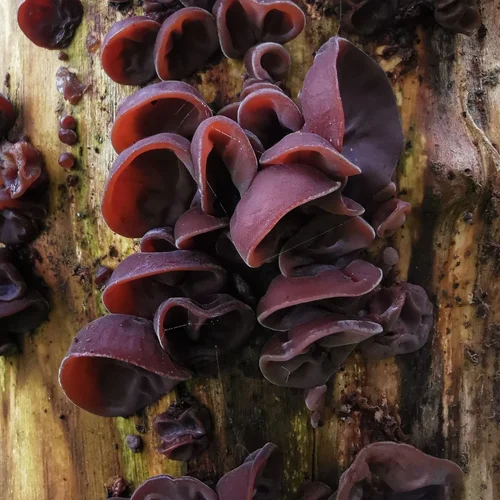
Although A. auricula judae and A. polytricha are two different species, they belong to the same genus, Auricularia, and share most of their active compounds and therapeutic effects.
Bioactive ingredients
Adenosine – The Cardiovascular Regulator
High adenosine content – Broad spectrum of activity:
Antiplatelet – Prevention of platelet aggregation
Anxiolytic – anxiety-relieving effect
Vasodilatory – Vessel-widening effect
Anti-inflammatory – Reduction of inflammatory processes
Polyphenols – The Antioxidants
High polyphenol content – dual action:
Antioxidant – Protection against free radicals
Cholesterol-lowering – Regulation of lipid metabolism
AAPs (Auricularia auricula Polysaccharides) – The Versatile Healer
Water-soluble fraction – Broad spectrum of activity:
Anticoagulant – Anticoagulant effect
Cardioprotective and cardiotonic – heart protection through free radical scavenging and anti-inflammatory effects
Cholesterol-lowering – Regulation of lipid metabolism
Immunomodulatory – Regulation of the immune response
Antitumor – Cancer-fighting properties
Antibacterial – Protection against pathogenic bacteria
Blood sugar-lowering – Glucose regulation
β-D-glucans – Immune system boosters
High β-D-glucan content (water-insoluble fraction):
Biological Response Modifier (BRM) – Antitumor Effect
Phospholipids – The Building Blocks of Cell Membranes
Cephalin and sphingomyelin – essential cell membrane components:
Supports the nervous system – Especially important for nerve tissue
Glucuronic acid – The anticoagulant
Anticoagulant – Anticoagulant effect
Terpenes – The Pain Relievers
Analgesic – Pain-relieving effect
Monoamine oxidase inhibitors (MAOIs) – The bronchitis fighter
Supports respiratory health – Effective for chronic bronchitis
Fibrinolytic enzymes – Blood thinners
Nattokinase, urokinase, streptokinase from A. polytricha:
Fibrinolytic – Dissolution of blood clots
Nutritional Profile – The Vital Package
Macronutrients (per 100 g):
Protein: 12.5 g
Fat: 1.7 g
Total carbohydrates: 66.1 g
Water-soluble polysaccharides: 10.2 g
Ash: 3.6 g
Therapeutic Applications
Cardiovascular Diseases – The Heart Protector
Thrombosis prevention:
Prevention of Myocardial Infarction – Antioxidant, Antithrombotic, and Cardioprotective Effects in Animal Studies
Protection Against Ischemic Stroke – Vascular Protective Properties
Combating Atherosclerosis – Evidence from In Vivo Mouse Studies
Improving blood circulation:
Peripheral Arterial Disease (PAD) – Improving Blood Flow
Intermittent claudication – Almost as effective as aspirin, but without side effects
Mucosal protection and improved blood circulation – The Mucosal Healer
Mucous membranes of the gastrointestinal tract:
Gastritis and Colitis – Anti-inflammatory Effects
Hemorrhoids – Improving Blood Circulation and Promoting Healing
Constipation – Evidence from clinical trials
Respiratory tract mucous membranes:
Bronchitis, sore throat, pharyngitis, laryngitis, sinusitis – Comprehensive respiratory support
Cough – Cough Relief
Metabolic Disorders – The Metabolic Regulator
Hyperlipidemia:
Regulation of lipid metabolism – efficacy confirmed in animal studies
Type 2 diabetes mellitus:
Pancreatic Regulation – Balancing Pancreatic Enzyme Secretion
Glycogen Regulation – Enhancing Glycogen Production and Storage
Blood Sugar Management – Better Control of Hypoglycemia and Diabetes
Hypertension:
Lowering Blood Pressure – Cardiovascular Regulation
Complementary Cancer Treatment – The Tumor Fighter
Gastrointestinal Cancer Specialist:
Improved clinical efficacy – Increased treatment effectiveness in colorectal, hepatocellular, gastric, pancreatic, and esophageal cancers
Improving immune function – boosting the immune system without increasing side effects
Hepatocellular carcinoma – Particularly effective for liver cancer
Other types of cancer:
Liver and Stomach Cancer – In Vitro Efficacy
Breast Cancer – In Vitro and In Vivo Experiments in Mice
Sarcom-180 – Efficacy against solid tumors in tumor-bearing mice
Lung Cancer – In Vitro Activity
Autoimmune Diseases – The Autoimmune Regulator
Sjögren's syndrome:
Relief from dryness – Improvement of dry skin, eyes, tear ducts, and mouth
Rheumatoid arthritis:
Joint support – Anti-inflammatory effect
Wound Healing – The Skin Regenerator
UV Protection and Healing:
Repair of UVB Damage – Antioxidant Effects on UV-Damaged Skin
Promoting collagen production – Supporting skin regeneration
Stimulation of cell proliferation – Promotion of fibroblast and keratinocyte proliferation, migration, and invasion
Traditional Uses – Knowledge Dating Back Thousands of Years
Bleeding Control – The Hemostatic Agent
Hemostatic:
Hemorrhoidal Bleeding – Local Hemostasis
Uterine Bleeding – Gynecological Care
Energy Restoration – The Energy Booster
Physical and mental energy:
Energy Replenishment – Boosting Mental and Physical Energy
Postpartum Recovery – Restoring Energy After Childbirth
Respiratory Support – The Lung Nourisher
Respiratory support:
Treatment for Strep Throat – Relief from Sore Throat
Dry cough – Cough relief
Promoting Blood Flow – Improving Overall Circulation
Vascular Diseases – The Vein Specialist
Postpartum thrombophlebitis – Treatment of venous inflammation after childbirth
Musculoskeletal System – The Muscle and Joint Relaxant
Inflammatory diseases:
Chronic neck and back pain – Long-term pain relief
Muscle pain, tendonitis, arthritis – Comprehensive musculoskeletal support
Relief from muscle tension:
Neck, Back, and Shoulder Pain – Targeted Relief from Tension
Headaches, tinnitus – Relief of symptoms caused by poor circulation
Menstrual cramps – Antispasmodic effect
Eye Health – The Eye Healer
Eye diseases:
Infections and styes – Local antimicrobial effect
Dry eyes – Moisture regulation
Other traditional uses
Jaundice – Liver Support
Anxiety and Insomnia – Calming the Nervous System
Skin Care – Moisturizing Effect
Safety considerations
Szechwan Purpura – A Rare Reaction
Sichuan Restaurant Syndrome:
Symptoms – Spotty bruises on the face the day after eating wood ear mushrooms
High-risk group – White women are particularly vulnerable
Pregnancy and the Desire to Have Children – Special Precautions
Implantation inhibition:
Reproductive effects – Potential inhibition of implantation in animals
Precaution – Pregnant women or women planning to become pregnant should avoid consuming this product
References
- Dr. Walter Ardigò. Healing with Medicinal Mushrooms. A Practical Handbook. Youcanprint; 2017. 394 pp.
- Stamets, P. Cultivation of Edible and Medicinal Mushrooms. 3rd ed. Berkeley, California: Ten Speed Press; 2000. 574 pp.
- Rogers, RD. The Mushroom Pharmacy: The Complete Guide to Medicinal Mushrooms and Lichens of North America. Berkeley, California: North Atlantic Books; 2011. 591 pp.
- Bianchi I, Marrocchesi R. Healing with Medicinal Mushrooms: Therapeutic Properties and Instructions for Use of the 12 Most Important Medicinal Mushrooms. Treviso: Editoriale Programma; 2015.
- Haertel B, Rimböck M, Neuerer T. Medicinal Mushrooms: Modulating, Restorative, and Strengthening. Salzburg: Druckerei Roser GmbH; 2019.
- Yu X, Wang R, Lai B, Tan M. Effects of Auricularia auricula fermentation broth on the liver and stomach of mice with acute alcoholism. Food Funct. January 7, 2021; 12(1):191–202.
- Bandara A. An overview of the content of polysaccharides, proteins, and selected nutrients in Auricularia and their potential pharmacological value. Mycosphere. 2019;10(1):579–607.
- Badalyan SM, Barkhudaryan A, Rapior S. Recent advances in research on the pharmacological potential of mushrooms and prospects for their clinical application. In: Agrawal DC, Dhanasekaran M, eds. Medicinal Mushrooms [Internet]. Singapore: Springer Singapore; 2019 [cited 2021 Dec 27]. pp. 1–70. Available at: http://link.springer.com/10.1007/978-981-13-6382-5_1
- Xiao B, Chen S, Huang Q, Zeng J, Zhang Y. Production of polysaccharides from the wood ear mushroom Auricularia auricula-judae (Agaricomycetes) using neutral protease and their antioxidant stress capacity. Int J Med Mushrooms. 2021;23(5):41–53.
- Mapoung S, Umsumarng S, Semmarath W, et al. Skin wound-healing potential of polysaccharides from the medicinal mushroom Auricularia auricula-judae (Bull.). J Fungi (Basel). March 25, 2021;7(4):247.
- Ibe V, Ihim SA, Ikegbunam M, Ugwu M, Nworu CS. Effect of the Nigerian edible and medicinal mushroom Auricularia auricula-judae (Agaricomycetes) on humoral and cellular immunity. Int J Med Mushrooms. 2020;22(5):467–78.
- Guthmann, J. Healing Mushrooms: The World’s Most Important Species: Description – Components – Effects. 2nd, updated and expanded edition. Wiebelsheim: Quelle & Meyer Verlag; 2021. 446 pp.
- Cephalin [Internet]. [Cited January 18, 2022]. Available at: https://www.bionity.com/en/encyclopedia/Cephalin.html
- Sphingomyelin. In: Wikipedia [Internet]. 2021 [cited January 18, 2022]. Available at: https://en.wikipedia.org/w/index.php?title=Sphingomyelin&oldid=1058433295
- Junior Letti LA, Destéfanis Vítola FM, Vinícius de Melo Pereira G, et al. Solid-State Fermentation for the Production of Mushrooms. In: Current Developments in Biotechnology and Bioengineering [Internet]. Elsevier; 2018 [cited January 18, 2022]. pp. 285–318. Available at: https://linkinghub.elsevier.com/retrieve/pii/B9780444639905000141
- Mohamed Ali S, Ling TC, Muniandy S, et al. Recovery and partial purification of fibrinolytic enzymes from Auricularia polytricha (Mont.) Sacc using an aqueous two-phase system. Separation and Purification Technology. February 2014;122:359–66.
- Kadnikova IA, Costa R, Kalenik TK, Guruleva ON, Shi Yanguo. Chemical composition and nutritional value of the mushroom Auricularia auricula-judae. Journal of Food and Nutrition Research. 2015;3(8):478–82.
- Rebensburg, P., & Kappl, A. Healthy with Medicinal Mushrooms: Strengthening the Immune System, Healing Illnesses, and Relieving Ailments. Munich: riva; 2020. 271 pp.
- Martin Powell. Medicinal Mushrooms. [Internet]. Place of publication not identified: Mycology Press; [cited December 27, 2021]. Available at: https://www.hoopladigital.com/title/11571096
- Zhang Y, Li X, Yang Q, et al. Antioxidant, anti-hyperlipidemic, and hepatoprotective effects of polysaccharides from Auricularia auricularis residue. Chem Biol Interact. January 5, 2021;333:109323.
- Ma Y, Wang C, Zhang Q, et al. The effect of polysaccharides from Auricularia auricula (Huaier) in the adjuvant treatment of gastrointestinal cancer: A systematic review and network meta-analysis. Pharmacol Res. June 2018;132:80–9.
- Ping Z, Xu H, Liu T, et al. Anticancer activity of rigid branched β-d-glucan and the effects of molecular weight. J Mater Chem B. July 14, 2016; 4(26):4565–73.
- Wong JH, Ng TB, Chan HHL, et al. Fungal extracts and compounds with inhibitory effects on breast cancer: Findings from studies using cultured cancer cells, tumor-bearing animals, and clinical trials. Appl Microbiol Biotechnol. June 2020; 104(11):4675–703.